
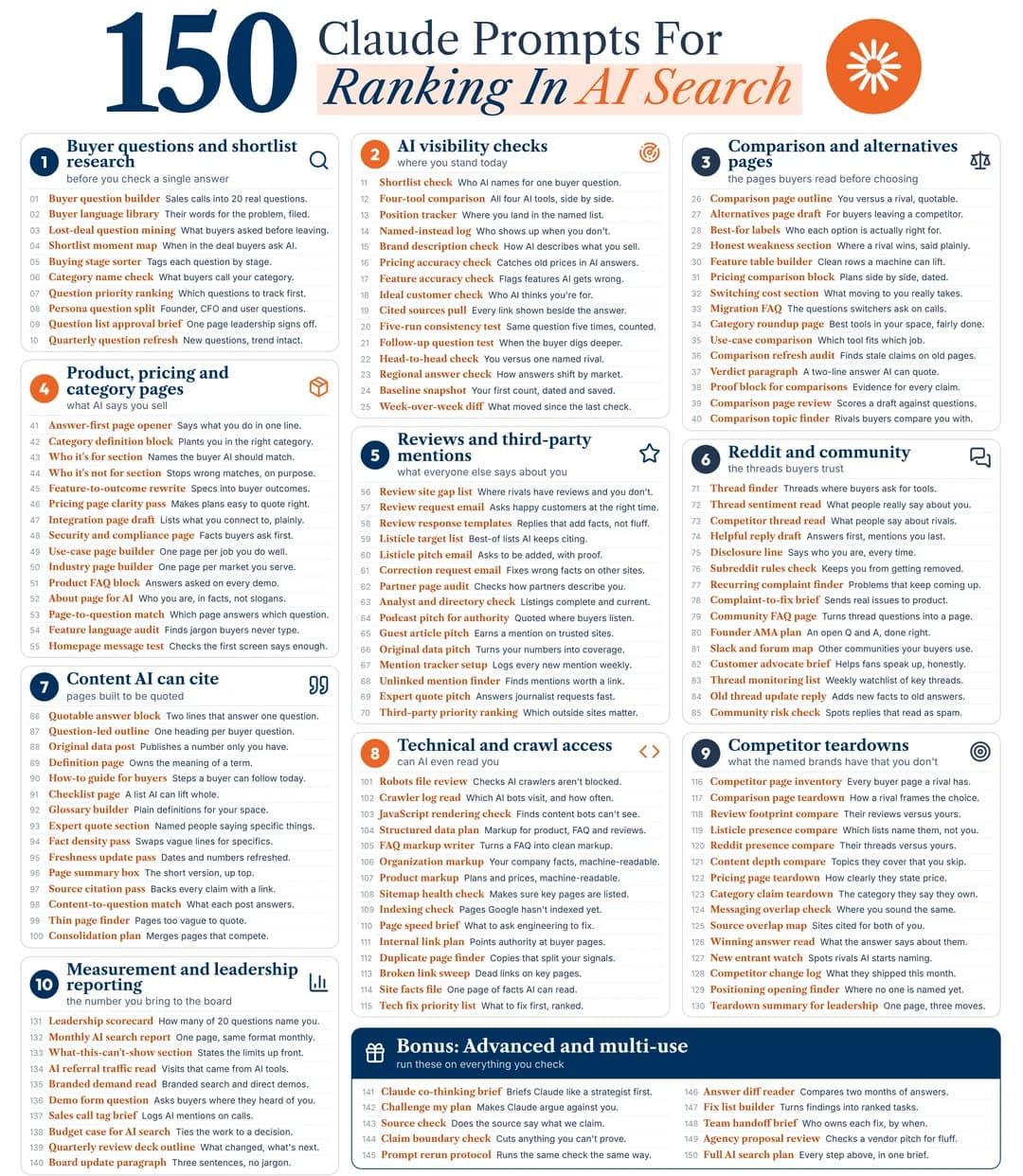

150 Claude PromptsFor Ranking In AI Search
150 complete Claude prompts for every part of AI search, from the questions your buyers ask to the report you bring to leadership. Fill in the brackets and run them.
 Brian SheltonFounder, Grow PredictablyFree · 150 Claude prompts · 11 sections
01 / 14 · Read this first
Who built this, and why
I’m Brian Shelton. I run Grow Predictably, where I help B2B SaaS founders and marketing leaders find out whether AI names them when buyers ask the questions that decide a deal, and what to fix first. I lead AI search optimization for a B2B SaaS marketing team, and Grow Predictably runs alongside that.
Using Claude for basic tasks gets you basic outputs. These 150 prompts are written the other way: every one tells Claude exactly what to work from, what to give back, and the rules it has to follow. You fill in the brackets with your own details.
Want to know where you show up today? Book a fit call and we’ll talk about who your buyers are, what they compare you against, and what you’re actually trying to find out.
02 / 14
How to use it
Fill in every bracket before you run a prompt. The more real detail you paste in, like call notes, page copy and the answers you got back, the better the output.
- Start with section 1. Most of the other prompts work from your 20 buyer questions. Write them from real sales calls and keep the list fixed, so next month’s numbers compare to this month’s.
- Check in all four tools. ChatGPT, Claude, Perplexity and Google AI Mode often give different answers to the same question.
- Log what you see, don’t guess why. Nobody can tell you for certain why an AI tool named one company over another, and a link shown beside an answer doesn’t prove that page produced it.
- Anything marked [needs input] is a fact you still need. Fill it before you publish, never with a guess.
03 / 14 · Prompts 1 to 10
Buyer questions and shortlist research
Before you check a single answer.
01Buyer question builderSales calls into 20 real questions.
I'm going to paste notes from [number] recent sales calls with [your ideal buyer, e.g. Heads of Marketing at B2B SaaS companies]. My company is [your company], and we sell [what you sell] in [your category]. From the notes, write the 20 questions a buyer would most likely type into ChatGPT, Claude, Perplexity or Google AI Mode while building a shortlist. Use the buyer's own wording from the notes wherever you can. Output a table with columns: question, the call note line it came from, and buyer role. Only include questions supported by something in the notes. If fewer than 20 are supported, stop at that number and tell me what kind of calls would fill the rest. Notes: [paste call notes]
02Buyer language libraryTheir words for the problem, filed.
Below are [call transcripts, support tickets, review text, or demo form answers] from buyers of [your category]. Pull every phrase they use to describe the problem they were trying to solve before they found a tool. Group the phrases into 5 to 8 themes. For each theme give: a theme name in plain words, every exact phrase quoted word for word, how many times it appears, and the source it came from. Then list up to 10 phrases from our homepage copy [paste homepage copy] that buyers never said. Don't paraphrase or clean up buyer wording, and don't add phrases that aren't in the text. Text: [paste source material]
03Lost-deal question miningWhat buyers asked before leaving.
Here are notes from [number] deals we lost in the last [time period], including CRM loss reasons and any call notes: [paste notes]. My company is [your company] in [your category]. Find the questions these buyers asked during the deal that we answered poorly or not at all. Rewrite each one as a buyer would type it into an AI tool. Output a table with columns: question, deal it came from, stage it was asked, and what the notes say we answered. Mark any row where the notes don't show what we said as "not recorded". Keep what the notes show separate from your interpretation, and don't guess why a deal was lost if the notes don't say.
04Shortlist moment mapWhen in the deal buyers ask AI.
I want to map where in our sales cycle buyers are likely to ask AI tools about vendors. Our typical deal: [describe stages, e.g. first touch, demo, trial, procurement], average length [number] days, buyer roles involved [list roles]. Here are notes on how recent buyers found and evaluated us: [paste notes or demo form answers]. Build a table with columns: deal stage, what the buyer is trying to decide, the kind of question they'd ask an AI tool, one example question in buyer wording, and the evidence from my notes. Where my notes give no evidence for a stage, write "no evidence" instead of filling it in. End with the 3 stages where I most need more data.
05Buying stage sorterTags each question by stage.
Here is my list of buyer questions for [your category]: [paste questions]. Tag each question with one buying stage: problem aware (they know the pain, not the solution), solution aware (they're comparing approaches), vendor comparison (they're naming or asking for tools), or decision (pricing, security, switching). Output a table with columns: question, stage, and a one-line reason for the tag based on the wording. Flag any question that could fit two stages and say which words make it unclear. Then give me a count per stage and tell me which stage my list is thin on. Don't rewrite the questions.
06Category name checkWhat buyers call your category.
My company is [your company]. We describe our category as [your category name], but buyers may call it something else. Here is buyer language from calls, reviews and demo forms: [paste text]. List every name buyers use for this kind of product, with exact quotes and how often each appears. Then, with web search on, look at how [competitor 1], [competitor 2] and [competitor 3] name the category on their homepages and record the exact wording with the URL. Output two tables: buyer terms (term, count, sample quote) and competitor terms (competitor, term, URL). Then tell me which term buyers use most and whether it matches ours. Use only what the text and pages show.
07Question priority rankingWhich questions to track first.
Here is my list of [number] buyer questions for [your category]: [paste questions]. I can only track 20 each month. Score each question from 1 to 5 on three things: how close it is to a buying decision, how often it came up in my source material [paste counts or notes], and how well it fits what we sell [describe your product in two lines]. Output a table with columns: question, decision score, frequency score, fit score, total, and a one-line reason. Sort by total. Mark any score where you had no data to go on as "guess" so I can check it. List the top 20 at the end.
08Persona question splitFounder, CFO and user questions.
We sell [what you sell] to companies where [list the roles, e.g. founder, CFO, end user] all weigh in on the decision. Here is my list of buyer questions: [paste questions]. Here is what each role cares about, from our calls: [paste notes by role]. Sort each question under the role most likely to ask it. Then write up to 5 more questions per role in that role's own wording, drawn only from the notes. Output one table per role with columns: question, source (my list or the notes), and the note line it came from. If a role has fewer than 5 supported questions, say so instead of making some up.
09Question list approval briefOne page leadership signs off.
I need my leadership team to sign off on the 20 buyer questions we'll track in AI search each month. Here is the list with stage and priority scores: [paste table]. Our company is [your company] in [your category]. Write a one-page brief of 250 to 350 words with these parts: what we're tracking and why, the 20 questions grouped by stage, how the list was built (sources used), what this tracking can show and what it can't, and the one decision I need from them. Use plain words for a reader outside marketing. Make no promises about results and use no acronyms. Don't invent facts, and mark anything missing as [needs input].
10Quarterly question refreshNew questions, trend intact.
Last quarter we tracked these 20 buyer questions: [paste list]. Here is new source material from this quarter's calls, reviews and demo forms: [paste text]. Suggest changes to the list, but keep at least 15 questions unchanged so our month-over-month numbers stay comparable. For each proposed change give: the question to drop, the question to add, the evidence from the new material, and what the swap does to our trend data. Output a table. Keep the wording of the questions we keep exactly as it is, even if you'd phrase it better. Mark any suggestion with thin support as "low evidence".
04 / 14 · Prompts 11 to 25
AI visibility checks
Where you stand today.
11Shortlist checkWho AI names for one buyer question.
Act as a B2B software buyer researching [your category]. With web search on, answer this question: [paste one buyer question from a real sales call]. List every vendor you name, in order. For each one, give the sentence that describes it and the links shown beside it. Then tell me whether [your company] was named, in what position, and whether the description matches this: [paste your one-line positioning]. Don't guess why any vendor was named.
12Four-tool comparisonAll four AI tools, side by side.
I asked this buyer question in ChatGPT, Claude, Perplexity and Google AI Mode on [date], each in a fresh chat: [paste question]. Here are the four answers, labeled by tool: [paste answers]. Build a table with one row per vendor named in any answer and one column per tool, showing that vendor's position in that answer or "not named". Put [your company] in the top row. Below the table, list which vendors appear in all four answers and which appear in only one. Add a count of how many of the four answers named [your company]. Work only from the text I pasted, and don't guess why the tools differ.
13Position trackerWhere you land in the named list.
Here are the AI answers I logged for my 20 tracked buyer questions this month, labeled by question and tool: [paste answers]. My company is [your company]. For each question and tool, record where we appear among the named vendors: 1st, 2nd, 3rd and so on, "mentioned outside the list" if we're named but not in the main list, or "not named". Output a table with columns: question, ChatGPT, Claude, Perplexity, Google AI Mode. Then give totals: how many answers named us and how many put us in the top 3, out of [number] answers checked. Count only, with no interpretation.
14Named-instead logWho shows up when you don't.
Here are AI answers to my tracked buyer questions where [your company] was not named: [paste answers, labeled by question and tool]. List every vendor named in these answers. Output a table with columns: vendor, number of answers that named them, which questions, which tools, and their typical position in the list. Sort by count. Then list any vendor that isn't on my known competitor list: [paste your competitor list]. Report only what the answers contain. Don't speculate about why these vendors were named, and don't rank them on anything other than the counts.
15Brand description checkHow AI describes what you sell.
Here is how we describe [your company] in our own words: [paste a one-paragraph description, plus category, buyer and core features]. Here are answers from ChatGPT, Claude, Perplexity and Google AI Mode to the question "What is [your company] and who is it for?": [paste answers]. Compare each answer to our description. Output a table with columns: tool, what it got right, what it got wrong (quote the sentence), what it left out, and whether the category it named matches ours. Mark each wrong statement as "outdated", "incorrect" or "unclear". Don't guess where the wrong information came from.
16Pricing accuracy checkCatches old prices in AI answers.
Our current pricing, as of [date]: [paste plan names, prices, billing terms and what each includes]. Here are AI answers to "[your company] pricing" and "how much does [your company] cost" from [list tools]: [paste answers]. Check every price, plan name and limit mentioned against our current pricing. Output a table with columns: tool, claim as stated (quoted), correct value, and status (correct, outdated, wrong, or not mentioned). If an answer shows a source, list the URL, but don't assume that source is where the number came from. End with a count of wrong or outdated claims per tool.
17Feature accuracy checkFlags features AI gets wrong.
Here is our current feature list with a one-line description of each: [paste list]. Here are features we've retired or never had: [paste list]. Here are AI answers to [paste questions, e.g. "what can [your company] do" and "does [your company] have [feature]"] from [list tools]: [paste answers]. Pull out every feature claim. Output a table with columns: tool, feature claim (quoted), status (correct, retired, never existed, or described wrong), and the correct statement from my list. Then list any of our current features that no answer mentions. Judge accuracy only against my lists.
18Ideal customer checkWho AI thinks you're for.
Our ideal customer: [describe company size, industry, buyer role and main problem]. Customers we're a poor fit for: [describe]. Here are AI answers to "who is [your company] best for" and "is [your company] good for [segment]" from [list tools]: [paste answers]. For each answer, pull out the customer type it describes. Output a table with columns: tool, customer type described (quoted), matches our ideal customer (yes, partly, no), and any poor-fit segment it named. Then list any segment we serve well that no answer mentioned. Report what the answers say, without guessing why they say it.
19Cited sources pullEvery link shown beside the answer.
Here are AI answers to my tracked buyer questions, with the source links each tool showed beside its answer: [paste answers and links, labeled by question and tool]. List every source. Output a table with columns: URL, site name, type of site (vendor site, review site, community thread, publication, directory, other), which questions and tools showed it, and whether the page mentions [your company], checked with web search on. Sort by how many answers showed it. A source shown beside an answer doesn't prove it produced the answer, so don't describe it that way. Just log what was shown.
20Five-run consistency testSame question five times, counted.
I ran this buyer question 5 times in [tool] on [date], each in a fresh chat: [paste question]. Here are the 5 answers, numbered: [paste answers]. Build a table with one row per vendor named in any run and columns for runs 1 to 5, showing that vendor's position or "not named". Add a final column: number of runs that named the vendor, out of 5. Put [your company] in the first row. Then say which vendors appeared in every run and which appeared only once. Treat each run as one data point, and don't explain the variation.
21Follow-up question testWhen the buyer digs deeper.
A buyer asked [tool] this question: [paste first question]. Here is the answer: [paste answer]. Then they asked these follow-ups: [paste follow-up questions, e.g. "which is best for a team of 50", "which has the best [feature]", "what do users complain about"]. Here are the follow-up answers: [paste answers]. For each step in the conversation, log: the question, vendors named and their positions, whether [your company] was named, and any claim about [your company] (quoted). Output one table. Then note the step where [your company] entered or dropped out of the conversation. Report only what the answers say.
22Head-to-head checkYou versus one named rival.
With web search on, answer this: "[your company] vs [competitor]: which is better for [use case]?" Give your answer as a buyer would see it. Then log it in a table with columns: point of comparison, what the answer said about [your company], what it said about [competitor], and the source shown for that point, if any. Add a final row for the verdict, quoted. Then list every claim about [your company] that doesn't match these product facts: [paste your own product facts]. Don't guess what shaped the verdict.
23Regional answer checkHow answers shift by market.
I asked the same buyer question in [tool] from [list regions or markets, e.g. US, UK, Germany] using [VPN, local accounts, or local-language versions] on [date]: [paste question]. Here are the answers, labeled by region: [paste answers]. Build a table with one row per vendor and one column per region, showing position or "not named". Put [your company] first. Then list vendors that appear in only one region. Note any difference in how [your company] is described between regions, quoting the sentences. Don't guess why the answers differ by region.
24Baseline snapshotYour first count, dated and saved.
This is our first AI search baseline, dated [date]. Here are answers to our 20 tracked buyer questions from ChatGPT, Claude, Perplexity and Google AI Mode: [paste answers, labeled by question and tool]. Our company is [your company] and our known competitors are [list]. Produce four things: 1) a table of question by tool showing our position or "not named", 2) a total of answers that named us out of [number], 3) a count of how often each competitor was named, 4) a list of wrong facts about us, quoted. Add a header with the date, tools used, and how the questions were asked (fresh chat, logged in or out, region). No commentary.
25Week-over-week diffWhat moved since the last check.
Here is last week's log of AI answers for our tracked questions, dated [date]: [paste log or table]. Here is this week's, dated [date]: [paste log or table]. Compare them. Output a table with columns: question, tool, last week's position for [your company], this week's position, and change (up, down, new, dropped, same). Then list competitors that were newly named or dropped. Give totals for both weeks. AI answers vary from run to run, so label any single-week change as "one check, not a trend". Don't explain why anything moved.
05 / 14 · Prompts 26 to 40
Comparison and alternatives pages
The pages buyers read before choosing.
26Comparison page outlineYou versus a rival, quotable.
Write the opening of a comparison page: [your company] vs [competitor]. Who it's for: [describe the buyer and their situation]. Where we're stronger: [two or three facts you can prove]. Where [competitor] is stronger: [be honest]. Start with a two-sentence verdict a buyer could quote, then a five-row table covering price, setup time, best for, key integration and support. 120 to 160 words. Don't invent facts. Mark anything missing as [needs input].
27Alternatives page draftFor buyers leaving a competitor.
Draft a page titled "[competitor] alternatives" for buyers who are leaving [competitor]. Common reasons buyers leave, from our calls: [paste notes]. Our product facts: [paste]. Other alternatives to cover fairly: [list 3 to 5 options with notes]. Structure: a 2-line opening answer, a short section on why people switch (from my notes only), one section per alternative with who it suits and its main limit, and a comparison table. Length: 900 to 1,300 words. Include [your company] as one option among several good ones. Don't invent facts, customers, numbers or quotes, and mark anything missing as [needs input].
28Best-for labelsWho each option is actually right for.
Here are the tools in [your category] I'm covering on a comparison page: [list tools, with notes on each from their public pages and our buyer calls]. Write a "best for" label for each one: a single line naming the specific buyer or situation it suits best, such as team size, budget, use case or must-have feature. Then add one line on who should look elsewhere. Output a table with columns: tool, best for, look elsewhere if, and the fact from my notes that supports it. Include [your company] and be as specific about our limits as about anyone else's. Mark any label without a supporting fact as [needs input].
29Honest weakness sectionWhere a rival wins, said plainly.
Write a section for our [your company] vs [competitor] comparison page called "Where [competitor] is the better choice". Here's where they're stronger, from our sales notes and their public pages: [paste notes]. Write 150 to 250 words in plain language. Name 2 to 4 situations where a buyer should pick [competitor] over us, and give the reason in one or two sentences each. No backhanded compliments, and don't turn any point into a pitch for us. Use only what my notes support. Don't invent facts, customers, numbers or quotes, and mark anything I'd need to confirm as [needs input].
30Feature table builderClean rows a machine can lift.
Build a feature comparison table for [your company], [competitor 1] and [competitor 2]. Our features: [paste]. Their features, from their public pages: [paste notes with URLs and the date checked]. Rows: the [number] features buyers ask about most: [list]. Cells may only say "Yes", "No", "Partial" with a one-line note, or [needs input]. Add a source column linking where each competitor fact came from. Write each row name the way buyers say it, not our internal feature names. Under the table, add the line "Checked on [date]." Don't fill any cell from memory or assumption.
31Pricing comparison blockPlans side by side, dated.
Build a pricing comparison block for [your company] vs [competitor 1] and [competitor 2]. Our pricing: [paste]. Their pricing, from their public pricing pages: [paste with URLs]. Columns: vendor, plan name, monthly price, annual price, what's included, main limit (seats, usage or features), and source link. Add a line at the top: "Prices checked on [date]. Check each vendor's site for current pricing." Where a vendor doesn't publish a price, write "Not listed publicly". Don't estimate, round or fill in any price, and mark anything missing as [needs input].
32Switching cost sectionWhat moving to you really takes.
Write a section titled "What switching from [competitor] to [your company] takes". Our onboarding facts: [paste setup time, data import options, help provided, any cost]. Common switching worries from our calls: [paste notes]. Length: 200 to 300 words. Cover the data you can bring over, what has to be rebuilt by hand, typical time to get running, who on the team needs to be involved, and what we help with. Be specific about the hard parts instead of skipping them. Don't invent timelines, customers, numbers or quotes, and mark anything missing as [needs input].
33Migration FAQThe questions switchers ask on calls.
Here are notes from sales and onboarding calls with buyers switching from [competitor] to [your company]: [paste notes]. Pull out the 10 to 12 questions they asked most about switching. Write a FAQ with each question in the buyer's wording and an answer of 40 to 80 words that gives a direct answer in its first sentence. Use only facts from these notes and this product information: [paste]. Where an answer depends on something I haven't given you, write [needs input] instead of guessing. Don't invent customers, numbers or quotes. List the questions in order of how often they came up.
34Category roundup pageBest tools in your space, fairly done.
Draft a page titled "Best [your category] tools for [buyer type] in [year]". Tools to include: [list 5 to 8, with notes on each from their public pages]. For each tool write: a 2-line summary, best for, main limit, starting price with source link, and one standout feature. Open with a 3-line answer naming which tool suits which buyer. Order the list by [chosen criteria, e.g. team size] and state the criteria at the top, so [your company] isn't first by default. Add "Last updated [date]". Don't invent facts, customers, numbers or quotes, and mark anything missing as [needs input].
35Use-case comparisonWhich tool fits which job.
Buyers in [your category] use these tools for different jobs. The jobs: [list 4 to 6 use cases]. The tools: [list, with notes on each]. Write a page section of 400 to 600 words with one H3 per use case. Under each, name the 1 or 2 tools best suited to that job and give the reason in 2 to 3 sentences, based on my notes. Then add a summary table with columns: use case, best fit, also good, and why. Recommend [your company] only where my notes support it. Don't invent facts or numbers, and mark anything unsupported as [needs input].
36Comparison refresh auditFinds stale claims on old pages.
Here is the text of our [your company] vs [competitor] comparison page, last updated [date]: [paste page]. Here is current information from both sides: our current product facts [paste] and [competitor]'s current public pages [paste with URLs, or check them with web search on]. List every factual claim on the page. Output a table with columns: claim (quoted), still correct (yes, no, can't confirm), current fact, and source. Flag every date, price, feature and plan name. Put claims you can't confirm in a separate list. Don't rewrite the page yet.
37Verdict paragraphA two-line answer AI can quote.
Write a verdict paragraph for the top of our [your company] vs [competitor] comparison page. Facts: [paste key differences, ideal customer for each, pricing]. The paragraph must answer "Which should I choose?" in 2 to 3 sentences, 40 to 60 words in total. Name the buyer who should pick each option, with one concrete reason each. Write it so it makes sense read on its own, out of context. Give me 3 versions. No hype, and no "it depends" without saying what it depends on. Don't invent facts or numbers, and mark anything missing as [needs input].
38Proof block for comparisonsEvidence for every claim.
Here is a draft comparison page: [paste page]. List every claim the page makes about [your company], such as faster, cheaper, easier, more features or better support. For each claim, say what evidence would back it up and whether I've given you any: [paste available proof such as data, docs, reviews, or public pages]. Output a table with columns: claim (quoted), evidence needed, evidence I have, and status (backed, needs proof, or cut). Suggest a plainer rewrite for each claim marked "needs proof". Don't invent proof, customers, numbers or quotes. Mark missing proof as [needs input].
39Comparison page reviewScores a draft against questions.
Here is a draft comparison page: [paste page]. Here are the buyer questions it should answer: [paste 8 to 12 questions]. Score the page on each question: 2 means answered directly in one place, 1 means answered partly or spread across sections, 0 means not answered. Output a table with columns: question, score, the section that answers it (quoted heading), and what's missing. Give the total out of [number]. Then list the 3 changes that would raise the score most. Judge only against these questions, and don't predict how AI tools will treat the page.
40Comparison topic finderRivals buyers compare you with.
I want to know which competitors buyers compare us with, so I build the right comparison pages. Sources: CRM competitor field export [paste], call notes [paste], and review site comparison sections [paste]. My company is [your company]. Count how often each rival comes up. Output a table with columns: rival, mentions per source, total, sample quote, and whether we already have a comparison page for them [paste list of existing pages]. Sort by total. Recommend the top 3 pages to build next, based on the counts only, and note any rival whose count rests on a single source.
06 / 14 · Prompts 41 to 55
Product, pricing and category pages
What AI says you sell.
41Answer-first page openerSays what you do in one line.
Write the opening of our [homepage or product page] for [your company]. Facts: what we sell [describe], who it's for [describe], the main problem it solves [describe], and our category [your category]. The first sentence must say what we do and for whom in under 25 words, using words a buyer would use. The second sentence adds the most important specific detail. Give me 5 versions, each 2 sentences and under 45 words in total. No slogans, and no words like "reimagine" or "empower". Current opener for reference: [paste]. Don't invent facts or numbers, and mark anything missing as [needs input].
42Category definition blockPlants you in the right category.
Write a short block for our site that defines [your category] and places [your company] in it. Facts: [paste what we do, plus how buyers describe the category on calls]. Structure: one sentence defining the category in plain words, one sentence on who uses it and why, one sentence naming [your company] as a [your category] tool for [buyer], and a 3-item list of what sets this kind of tool apart from [neighboring category]. Length: 80 to 120 words. Use the category name buyers use most. Don't invent facts, and mark anything missing as [needs input].
43Who it's for sectionNames the buyer AI should match.
Write a "Who [your company] is for" section. Facts about our best customers: [paste company size, industry, team, buyer role, problem, current tools]. Write 4 to 6 bullets, each naming a specific buyer and situation in one line, for example "Marketing leads at B2B SaaS companies with 20 to 200 staff who [situation]". Then write one paragraph of 50 to 80 words describing the typical buyer and what they're trying to get done. Use buyer wording from these notes: [paste]. Don't invent customers, numbers or quotes, and mark anything missing as [needs input].
44Who it's not for sectionStops wrong matches, on purpose.
Write a "Who [your company] isn't for" section. Here are deals we lost or customers who churned because of poor fit: [paste notes]. Here's what we don't do: [paste list]. Write 3 to 5 bullets, each naming a buyer or situation that's a poor fit in one line, plus what they should look for instead, described as a type of tool rather than a brand. Keep it plain and specific, and don't let it read as a hidden boast. Don't invent facts, customers or numbers, and mark anything I'd need to confirm as [needs input].
45Feature-to-outcome rewriteSpecs into buyer outcomes.
Here is our feature list as written on our site: [paste features and descriptions]. Here is what customers say each feature helps them do, from calls and reviews: [paste notes]. Rewrite each feature as three parts: the feature name in buyer wording, one sentence on what it does, and one sentence on the outcome for the buyer. Output a table with columns: current text, new feature name, what it does, outcome, and the note it's based on. Where no note supports an outcome, write [needs input] instead of inventing one. Use no numbers I haven't given you, and don't invent customers or quotes.
46Pricing page clarity passMakes plans easy to quote right.
Here is our pricing page text: [paste page]. Rewrite it so each plan can be quoted correctly out of context. For each plan, give on separate lines: plan name, price per month and per year, billing unit (per seat, per account, or usage), what's included, the main limit, and who it's for. Add a "Pricing as of [date]" line. Then list anything on the current page that's unclear, such as "contact us" with no reason given or limits stated only in footnotes. Don't change any price or limit, don't invent facts, and mark anything missing as [needs input].
47Integration page draftLists what you connect to, plainly.
Draft our integrations page. Integrations we support: [paste list with type (native, API, or third-party connector), what data syncs, and which plan includes it]. Buyer questions about integrations from calls: [paste]. Structure: a 2-line opening saying what we connect to, a table with columns integration, type, what syncs, plan, and setup time, then a FAQ of 5 questions with answers of 30 to 60 words each. Use only the facts given. Don't invent integrations, setup times, customers or quotes, and mark anything missing as [needs input].
48Security and compliance pageFacts buyers ask first.
Draft our security and compliance page. Our facts: [paste certifications held with dates, data hosting regions, encryption, access controls, SSO, data retention, subprocessors, uptime commitment]. Questions buyers and procurement teams ask us: [paste from security questionnaires or calls]. Structure: a 3-line summary at the top, one section per topic with a heading in buyer wording, and a list of documents available on request. Length: 500 to 800 words. Say only what we hold today, and never imply a certification we don't have. Don't invent facts or numbers, and mark anything missing as [needs input].
49Use-case page builderOne page per job you do well.
Draft a use-case page for [your company] on [use case]. Facts: the problem buyers have [describe], how they handle it today [describe], how our product helps, step by step [describe], features used [list], and who on the team uses it [describe]. Structure: a 2-line opening answer, the problem in buyer words, how it works in 3 to 5 steps, features used, and a FAQ with 4 questions. Length: 600 to 900 words, written for [buyer role]. Don't invent customers, numbers, results or quotes, and mark anything missing as [needs input].
50Industry page builderOne page per market you serve.
Draft an industry page: [your company] for [industry]. Facts: why this industry needs this kind of tool [describe], industry-specific needs or rules [describe], features that matter most to them [list], integrations they use [list], and how many customers we have in this industry [number, or leave blank]. Structure: a 2-line opening answer, 3 problems specific to this industry, how we help with each, relevant features, and 4 FAQs. Length: 600 to 900 words, in the industry's own terms. Don't invent customers, numbers, logos or quotes, and mark anything missing as [needs input].
51Product FAQ blockAnswers asked on every demo.
Here are notes from [number] recent demos: [paste notes]. Pull out the 10 questions buyers asked most. Write a FAQ block with each question in the buyer's wording and an answer of 40 to 80 words. The first sentence of each answer must answer the question directly, and the rest adds detail. Use only facts from the notes and our product information: [paste]. Where a question needs facts I haven't given you, write [needs input] instead of guessing. Don't invent customers, numbers or quotes. List the questions in order of how often each came up, with the count beside each.
52About page for AIWho you are, in facts, not slogans.
Rewrite our About page as a fact sheet. Facts: company name, founded [year], headquarters [location], founders [names and backgrounds], team size [number], what we sell [describe], category [your category], who we serve [describe], funding [if public], and key product dates [list]. Current page: [paste]. Write a 3-sentence summary at the top, then a list with one fact per line, then 150 to 250 words of company story in plain words. Remove slogans and mission lines that say nothing specific. Don't invent facts, numbers or quotes, and mark anything missing as [needs input].
53Page-to-question matchWhich page answers which question.
Here are our 20 tracked buyer questions: [paste list]. Here is a list of our site pages with URL, title and a one-line summary of each: [paste list or sitemap with summaries]. Match each question to the page that answers it best. Output a table with columns: question, best page URL, how well it answers (directly, partly, not at all), and what the page is missing. Then list every question with no matching page, and every page that matches no question. Base each match on what the page summaries say, and flag any match you couldn't confirm from them.
54Feature language auditFinds jargon buyers never type.
Here are the words we use on our site for our features and category: [paste feature names, navigation labels, headings]. Here are buyer words from calls, reviews and support tickets: [paste text]. For each of our terms, check whether buyers ever use it. Output a table with columns: our term, used by buyers (yes or no), the buyer term for the same thing (quoted), how often it appears, and a suggested replacement. Flag internal names and made-up terms buyers never say. Use only the text I gave you, and mark any term with no buyer equivalent in the text as [needs input].
55Homepage message testChecks the first screen says enough.
Here is the text visible on the first screen of our homepage, before scrolling: [paste]. Answer these questions as a buyer would, using only that text: What does this company sell? Who is it for? What category is it in? What does it cost, or how would I find out? What should I do next? Output a table with columns: question, answer from the text, and clear (yes, partly, no). Then list what a buyer would still need to know, and write 2 rewrites of the headline and subhead that answer more of these questions. Don't invent facts, and mark anything missing as [needs input].
07 / 14 · Prompts 56 to 70
Reviews and third-party mentions
What everyone else says about you.
56Review site gap listWhere rivals have reviews and you don't.
I'm going to paste the review profiles for [your company] and [competitor 1], [competitor 2] and [competitor 3]. For each one I'll give the review site, review count, average rating and date of the most recent review: [paste data]. Build a table with these columns: review site, our count, each competitor's count, our latest review date, and the competitor with the most reviews there. Below the table, list the 3 sites where competitors have the most reviews and we have fewer than 10, with one line each on why a B2B SaaS buyer in [your category] might read that site. Use only the numbers I gave you. If a cell is missing, write [needs input].
57Review request emailAsks happy customers at the right time.
Write a review request email for [your company] to send to a real customer who just [describe the moment, e.g. renewed, hit a usage milestone, gave a 9 or 10 on a survey]. Customer name: [name]. What they've done with us: [describe their use, in facts]. Review site: [site name and link]. Keep the email under 120 words with a subject line under 8 words. Ask for an honest review, good or bad, and say it takes about [time]. Offer no gift, discount or reward unless the review site's policy allows it: [paste the site's incentive policy]. Do not invent anything about the customer's results. Mark any missing fact as [needs input]. Give me 2 versions: one from the founder, one from their account manager.
58Review response templatesReplies that add facts, not fluff.
Write replies to reviews of [your company] on [review site]. Here are 5 recent reviews: [paste reviews]. For each review, write a reply of 50 to 90 words that thanks the reviewer by name if shown, responds to the specific point they raised, and adds one plain fact a future buyer would find useful, such as a feature, a plan detail or a fix we shipped. For negative reviews, own the problem, say what changed only if I've told you, and offer a direct contact: [contact]. Facts I can confirm: [paste product facts and recent changes]. Do not invent fixes, dates or numbers. Mark anything missing as [needs input]. No slogans.
59Listicle target listBest-of lists AI keeps citing.
Help me build a target list of best-of articles for [your category]. I asked these buyer questions in ChatGPT, Claude (with web search on), Perplexity and Google AI Mode and copied the sources shown beside each answer: [paste questions and source links]. Group the links into a table with these columns: article title, site, URL, times shown across my checks, tools it was shown in, whether [your company] is named in the article (from my notes: [paste]), and last updated date if visible. Sort by times shown. A source shown beside an answer doesn't prove it produced the answer, so call the column "times shown" and make no claim about influence. Flag the top 10 to contact first.
60Listicle pitch emailAsks to be added, with proof.
Write a pitch email asking the editor of [article title and URL] to consider adding [your company]. What the article covers: [summary]. Who it's written for: [audience]. Facts about us: [category, who we serve, one thing we do that the listed tools don't, starting price, review count and rating with the source]. Keep it under 130 words. Open with a specific point about their article so it's clear I read it. Suggest the exact section where we'd fit and a 40-word blurb they could use. Offer a demo account or a short call. Do not invent customers, numbers or quotes. Mark missing facts as [needs input]. No flattery and no exclamation marks.
61Correction request emailFixes wrong facts on other sites.
Write a correction request email to [site name] about their page [URL]. What the page says now: [paste the wrong text]. What's correct: [correct fact]. Proof: [link to our pricing page, changelog, docs or press release]. Keep it under 110 words. Quote the wrong line exactly, give the correct version in one sentence, and link the proof. Offer replacement wording they can paste in. Keep it polite and brief, with no blame. Do not add any facts I haven't given you. If the proof is missing, write [needs input] where the link would go. Add a subject line under 8 words.
62Partner page auditChecks how partners describe you.
Review how our partners describe [your company]. Here's the text from each partner's page about us: [paste partner name, URL and text for each]. Here's how we describe ourselves: [paste your one-line description, category and who you serve]. Build a table with these columns: partner, URL, category they put us in, who they say we serve, outdated or wrong facts, and suggested replacement text under 40 words. Then list the 3 partners whose pages differ most from our own description, and draft a short, friendly update request for each. Only flag something as wrong if it conflicts with what I gave you. Mark unclear items as [needs input].
63Analyst and directory checkListings complete and current.
Check our directory and analyst listings. For each listing I'll paste the URL and the text shown: [paste listings]. Our current facts: [company name, category, founding year, HQ, starting price, main integrations, website, logo]. Make a table with these columns: site, URL, fields that match, fields that are wrong or missing, and the fix. Then write a checklist of what to update on each site, ordered by which listings buyers in [your category] are most likely to see. Base that order on this list: [paste your list, or write "use your judgment and say that you did"]. Don't invent fields a site doesn't have. Mark anything you can't confirm as [needs input].
64Podcast pitch for authorityQuoted where buyers listen.
Write a podcast guest pitch for [your name], [role] at [your company]. Show: [podcast name]. Host: [host name]. Audience: [describe]. Two recent episodes I listened to: [titles, with one note on each]. Topics I can speak on from real experience: [list 2 to 3, with the specific experience behind each]. Write a pitch email under 140 words that references one of those episodes by name, then gives 3 episode ideas, each with a title and one sentence on what listeners would take away. Add a subject line under 8 words. Do not invent results, client names or numbers. Mark anything missing as [needs input]. No hype words.
65Guest article pitchEarns a mention on trusted sites.
Write a guest article pitch to [publication], editor [name]. Their guest post guidelines: [paste]. Their readers: [describe]. Their 5 most recent headlines: [paste]. My background on this topic: [describe the specific experience that gives you authority]. Give me 3 article ideas, each with a working title, a 2-sentence summary, and the one specific point the piece makes that their recent articles haven't covered. Then write the pitch email in under 120 words using the strongest idea. Follow their guidelines exactly. Do not invent data, customers or quotes. Mark anything missing as [needs input].
66Original data pitchTurns your numbers into coverage.
Help me turn our data into a pitch a reporter can use. The data: [paste a summary, sample size, date range, and how it was collected]. Find the 5 most specific findings a [industry] reporter would care about. For each one, write the finding in one sentence with the exact number, then note any limit on what the data can show. Then write a pitch email under 130 words to [reporter name, outlet] that leads with the strongest finding and offers the full method on request. Use only the numbers in the data I pasted, and don't round in ways that change the meaning. Mark anything missing as [needs input].
67Mention tracker setupLogs every new mention weekly.
Set up a weekly mention log for [your company]. Sources I'll check each week: [list, e.g. Google Alerts, review sites, Reddit search, LinkedIn search, news search]. Build a table template with these columns: date found, site, URL, type (review, listicle, news, forum, partner, podcast), what it says about us in under 20 words, accurate (yes or no), links to us (yes or no), and next action. Then write the exact search strings I should save for each source, using [your company], [product name], [founder name] and [common misspelling]. Finish with a 10-minute weekly routine in 5 steps.
68Unlinked mention finderFinds mentions worth a link.
Here's a list of pages that mention [your company]: [paste URLs and the text around each mention]. These ones already link to us: [paste]. Build a table of the unlinked mentions with these columns: page, site, the sentence that names us, the most relevant page on our site to link to (chosen from this list: [paste key URLs]), and whether a link request makes sense (yes, maybe or no, with a reason under 15 words). Then write one link request email under 80 words that I can adapt for each site. Don't offer anything in return for the link. Don't invent facts about us or the page.
69Expert quote pitchAnswers journalist requests fast.
Write a reply to this journalist request: [paste the request, deadline and outlet]. My name and role: [name, title, company]. My relevant experience: [describe the specific experience]. Facts I can back up: [paste]. Give me 3 quotable answers of 40 to 60 words each. Each should answer their exact question in the first sentence and include one specific fact or example from my list. Add a one-line bio and follow any format they asked for. Keep the whole reply under 200 words. Do not invent numbers, customers or examples. Mark anything missing as [needs input]. No buzzwords.
70Third-party priority rankingWhich outside sites matter.
Rank the outside sites I could work on for [your company]. Here's my list with what I know about each: [paste site, type, whether we're on it, which rivals are on it, times it was shown as a source in my AI search checks, effort estimate]. Score each site 1 to 5 on: times shown as a source in my checks, how many rivals are on it, how likely buyers in [your category] are to read it, and effort (5 means easiest). Output a table with these columns: site, the four scores, total, and first action. Sort by total. Under the table, note that a source shown beside an answer doesn't prove it produced the answer. Use only my data and mark unknowns as [needs input].
08 / 14 · Prompts 71 to 85
Reddit and community
The threads buyers trust.
71Thread finderThreads where buyers ask for tools.
Help me find Reddit threads where buyers ask for tools in [your category]. With web search on, look for posts from the last [12] months asking for recommendations, alternatives to [competitor], or help with [problem you solve]. Return up to 20 threads in a table with these columns: thread title, subreddit, URL, date, number of comments, what the poster asked in one line, and tools named in replies. Only include threads you can link to. Then list the 5 threads where a disclosed, helpful reply from someone at [your company] would add something the thread doesn't already have, and remind me to check each subreddit's rules before replying.
72Thread sentiment readWhat people really say about you.
Read these Reddit and forum threads that mention [your company]: [paste thread text or links]. For each mention, record: thread, date, what the person said in under 20 words, tone (positive, mixed, negative or neutral), and topic (pricing, support, features, onboarding or other). Output that as a table. Then summarize in 5 bullets: what people praise, what they complain about, and anything that repeats across 3 or more threads, with the exact words quoted where useful. Don't read meaning into posts beyond what they say. Don't count the same person twice.
73Competitor thread readWhat people say about rivals.
Read these threads about [competitor]: [paste thread text or links]. Build a table with these columns: thread, date, what people like, what people complain about, who they say it's best for, and whether anyone mentions switching (to or from, and which tool). Then list the top 5 complaints by how often they come up, with a count and one exact quote each. Finish with 3 topics where someone from [your company] could post a useful, disclosed reply that helps the reader even if they never switch. Stick to what's written and don't guess at reasons.
74Helpful reply draftAnswers first, mentions you last.
Draft a reply to this Reddit thread: [paste thread]. Subreddit rules: [paste rules]. I work at [your company] and must say so. What I know that would help: [specific experience or facts]. Write the reply in under 180 words. Answer the poster's actual question first, with practical advice they can use whether or not they buy anything. Mention other good options fairly, including [competitor] if it fits their need. Mention [your company] only at the end, only if it's relevant, with this disclosure: [disclosure line]. No links unless the rules allow them. Do not invent facts, customers or numbers. Mark anything missing as [needs input].
75Disclosure lineSays who you are, every time.
Write 6 disclosure lines my team at [your company] can use when replying in online communities. Our people who reply: [list roles, e.g. founder, product manager, support lead]. Each line should say who I am and where I work in under 20 words, sound like a normal person talking, and fit at the start of a reply. Give me 2 for Reddit, 2 for Slack communities and 2 for LinkedIn groups. Then write 3 short team rules on using them: disclose in every reply that touches our product or category, put it at the start, and never hide it at the end or in small print.
76Subreddit rules checkKeeps you from getting removed.
Here are the rules and sidebar for r/[subreddit]: [paste rules]. Here's the reply I want to post: [paste draft]. Check my draft against every rule. Give me a table with these columns: rule, does my draft follow it (yes, no or unclear), and the exact change needed. Then answer: are vendor replies allowed at all, are links allowed, and is there a self-promotion limit or a weekly promo thread I should use instead. If the rules don't say, write "not stated" and suggest I ask the moderators. Finish with a revised draft that follows every rule and opens with my disclosure: [disclosure line].
77Recurring complaint finderProblems that keep coming up.
Here are [number] community posts and replies about problems in [your category]: [paste text from Reddit, forums, review sites or Slack, with links]. Find the problems that come up more than once. Output a table with these columns: problem in plain words, times mentioned, sources, one exact quote, and whether it's about us, a competitor, or the category in general. Sort by count. Only count a problem when the post states it outright. Then list the top 3 problems we could write a helpful public answer about, and say which buyer question each one connects to.
78Complaint-to-fix briefSends real issues to product.
Turn these community complaints about [your company] into a brief for our product team: [paste complaints with links and dates]. For each issue, write: the problem in one sentence, how many times it appeared, 2 exact quotes with links, which plans or customer types it seems to affect (only if the posts say so), and the question product needs to answer. Order issues by count and keep the brief under 400 words. Don't propose solutions or timelines, since that's product's call, and don't guess at causes. End with a list of the threads where we could post a disclosed reply once product has an answer.
79Community FAQ pageTurns thread questions into a page.
Turn questions people ask in communities into an FAQ page for [your company]. Questions I collected, with links: [paste]. Our facts: [paste product, pricing, setup and integration facts]. Group the questions into 4 to 6 themes. Write each question in the buyer's own words, then answer it in 40 to 80 words, with the direct answer in the first sentence. Use only the facts I gave you. Where we don't have an answer, write [needs input]. Output in markdown with a heading per theme and a one-line intro at the top of the page. No sales language and no invented facts, customers or numbers.
80Founder AMA planAn open Q and A, done right.
Plan an AMA (an open Q and A) for [founder name], founder of [your company], in [community name]. The community's rules for AMAs: [paste rules, or write "ask moderators"]. Topics they can speak on honestly: [list]. Give me: a request to the moderators under 100 words, an AMA title and intro post under 150 words that clearly says who they are and where they work, 10 likely questions with notes on answering each (include hard ones about [known weak points]), and a plan for the next 48 hours. No questions planted by staff or friends, no extra accounts, and no promo codes unless the moderators approve them.
81Slack and forum mapOther communities your buyers use.
Help me map the communities where [your buyer, e.g. Heads of Marketing at Series A SaaS companies] talk shop. With web search on, find Slack groups, Discord servers, forums, LinkedIn groups and subreddits for [your category] and [buyer role]. Return a table with these columns: community, platform, link, size if stated, how to join, whether vendors may post, and main topics. Only list communities you found a source for, and cite it. Then rank the top 5 by fit with our buyer, and for each one write a way to be useful there first, long before mentioning our product.
82Customer advocate briefHelps fans speak up, honestly.
Write a short brief for real customers of [your company] who've told us they like the product and are happy to talk about it. The brief should thank them, say plainly that we're not asking them to post anything specific, explain how to say they're a customer when they post, and state what we've given them, if anything: [describe, or write "nothing"]. Point to communities where questions in our category come up: [list]. Ask them to share their honest view, downsides included, and to follow each community's rules. Keep it under 250 words in a plain, friendly tone. No scripts, no talking points to copy, and no reviews asked for in exchange for anything.
83Thread monitoring listWeekly watchlist of key threads.
Set up a weekly watchlist for community threads about [your category]. Our terms: [your company], [product name], [competitor 1], [competitor 2], and [phrases buyers use for the problem]. Communities: [list subreddits and forums]. Give me the exact search strings for Reddit search and for Google (site:reddit.com style) for each term. Then give me a table template with these columns: date, thread, URL, community, topic, mentions us, mentions rivals, reply needed, and who replies. Finish with a 15-minute weekly routine in 5 steps, including this rule: every staff reply is disclosed and follows that community's rules.
84Old thread update replyAdds new facts to old answers.
This thread is [age] old and still comes up when people search for [topic]: [paste thread]. Its information about [your company] or [your category] is out of date. What changed: [describe, with a proof link]. The subreddit's rules on replying to old threads: [paste]. Draft a reply under 120 words that adds the updated facts for people who find the thread later. Open with my disclosure: [disclosure line]. Correct only what's out of date, and add one useful point for anyone reading. If the rules don't allow replies to old threads, say so and stop there. Don't invent facts. Mark anything missing as [needs input].
85Community risk checkSpots replies that read as spam.
Check these draft community replies before my team posts them: [paste each draft with its community name]. That community's rules: [paste rules]. Check each draft on: disclosure (clear at the start, or missing), helpfulness (answers the question without needing our product), fairness to other options, links, sales language, and fit with the rules. Output a table with these columns: draft, a pass or fix for each check, spam risk (low, medium or high), and the exact edit. Flag anything that could look like astroturfing, such as several staff replying in one thread or praise without disclosure. Rewrite the high-risk drafts.
09 / 14 · Prompts 86 to 100
Content AI can cite
Pages built to be quoted.
86Quotable answer blockTwo lines that answer one question.
Write a short answer block for this buyer question: [question]. The page it goes on: [URL or page topic]. Facts I can stand behind: [paste facts and numbers, with sources]. Write 3 versions of 40 to 60 words each. Each one should answer the question in the first sentence, include one specific fact or number from my list, say who the answer applies to, and make sense read alone, without the rest of the page. Don't open with "It depends" and don't restate the question. Do not invent facts or numbers. Mark anything missing as [needs input].
87Question-led outlineOne heading per buyer question.
Build an outline for a page on [topic] for [buyer role] at [type of company]. Buyer questions I've collected on this topic: [paste 8 to 15 questions]. Use one H2 per question, in the order a buyer would ask them. Under each H2, give a direct answer of 1 to 2 sentences, 3 bullets on what the section must cover, and the proof we need (data, screenshot, customer quote or link). What proof we have: [paste]. Mark the rest as [needs input]. Add a page title under 60 characters and a 2-sentence summary. Merge questions that overlap and tell me which ones you merged.
88Original data postPublishes a number only you have.
Help me write a post around data only [your company] has. The data: [paste a summary, sample size, date range, and how it was collected]. Give me 3 headline options under 70 characters, each with a specific number. Then an opening paragraph under 60 words stating the main finding, 5 findings written as a one-sentence claim with its number plus 2 sentences of context, a "how we got this data" section under 100 words, and a "what this data can't tell you" section with 3 limits. Use only the numbers I pasted, and don't round in ways that change the meaning. Mark anything missing as [needs input].
89Definition pageOwns the meaning of a term.
Write a definition page for the term [term] in [your category]. How our buyers use the term: [paste examples from calls, threads or searches]. Facts and examples I can use: [paste]. Structure it as: a one-sentence definition under 30 words at the top, a plain explanation under 120 words, a list of what the term includes and what it doesn't, 3 examples drawn from what I gave you, how it differs from [related term], and 4 FAQs with answers of 40 to 60 words. Mention [your company] once at most, near the end. Do not invent facts. Mark anything missing as [needs input].
90How-to guide for buyersSteps a buyer can follow today.
Write a how-to guide for [buyer role] on how to [task]. Who's reading: [describe their setup and skill level]. Tools they likely have: [list]. Steps we know work, from our own experience: [paste notes]. Give me a title starting with "How to", a 2-sentence intro on who this is for and how long it takes, 6 to 10 numbered steps (each with a bold action line and 30 to 60 words of detail), 3 common mistakes, and a short checklist at the end. Make the guide useful without our product, and mention [your company] in one step only if it fits. Do not invent steps or results. Mark anything missing as [needs input].
91Checklist pageA list AI can lift whole.
Turn this topic into a checklist page: [topic, e.g. how to evaluate a [category] vendor]. Source material: [paste notes, sales call questions or internal docs]. Write a title under 60 characters, an intro under 50 words saying who the checklist is for, then 15 to 25 items grouped under 3 to 5 headings. Start each item with a verb, keep it under 15 words, and add a one-line "why it matters" under it. Number the items so people can refer to them. Keep it neutral enough that a buyer could use it to judge any vendor, us included. Don't add requirements I didn't give you. Mark unclear items as [needs input].
92Glossary builderPlain definitions for your space.
Build a glossary for [your category]. Terms to include: [paste a list, or write "suggest 20 from these notes" and paste the notes]. For each term, give a plain definition under 30 words, one example sentence a buyer might actually say, and one related term from the list. Sort alphabetically and output as a markdown table with these columns: term, definition, example, related term. Don't define a term with other jargon; if you have to, point to that term's own entry. Flag any term where our usage differs from the market's: [paste our usage notes]. Don't invent industry stats or facts.
93Expert quote sectionNamed people saying specific things.
Write an expert quote section for our page on [topic]. Here are the real quotes I have, each with the person's name, title, company and where the quote came from: [paste quotes]. Pick the 3 to 5 most specific ones. For each, write a one-sentence lead-in naming the person and their role, then the quote exactly as given. Trim only for length, using "..." and never changing the meaning. Flag any quote that's vague (no number, example or specific claim) and suggest a follow-up question to get a sharper one. Never write or reword a quote into something the person didn't say. Mark missing attribution as [needs input].
94Fact density passSwaps vague lines for specifics.
Edit this page to swap vague lines for specific ones: [paste page]. Facts I can use: [paste numbers, dates, customer counts and feature details, with sources]. Go through the page line by line. Output a table with these columns: original line, what's vague about it, rewritten line, and the fact used. Only rewrite a line when a fact from my list fits it. For the rest, write [needs input] and name the specific fact that would fix the line. Keep my tone. Don't add claims, numbers or customers I didn't give you. Then give me the full revised page.
95Freshness update passDates and numbers refreshed.
Review this page for anything out of date: [paste page and its publish date]. Current facts: [paste current pricing, features, integrations and stats, with dates]. Today's date: [date]. Make a table with these columns: line, what's outdated (date, number, example, screenshot reference or product name), the current version, and its source. Flag any stat older than [18 months] even when I have no replacement, and mark those [needs input]. Then write a "last updated" line and a 2-sentence note on what changed. Don't change the page date unless the content changed.
96Page summary boxThe short version, up top.
Write a summary box for the top of this page: [paste page]. Who reads it: [buyer role]. Give me 3 versions. Each one has a one-line answer to the main question the page covers, under 25 words, then 3 to 5 bullets of key points under 15 words each, with any numbers taken from the page, then one line saying who the page is for. Use only what's on the page. If the page doesn't clearly answer its own main question, say so and tell me what's missing rather than filling it in yourself.
97Source citation passBacks every claim with a link.
Check this page for claims that need a source: [paste page]. Sources I have: [paste links, with a one-line note on each, and the source text where you can]. Output a table with these columns: claim, type (stat, comparison, product fact or opinion), the source from my list that supports it, and whether the source says exactly what we say (yes, partly or no). Only mark "yes" when you've seen the source text. Where no source fits, name the kind of source needed and mark it [needs input], or suggest softening or cutting the claim. Don't invent links or credit a source with a claim it doesn't make.
98Content-to-question matchWhat each post answers.
Match our content to the buyer questions we track. Questions, with the priority I gave each: [paste list]. Our pages, with URL, title and a one-line summary of each: [paste]. Build a table with these columns: buyer question, best-matching page, how fully it answers (fully, partly or not at all), what's missing in one line, and action (update the page, write a new page, or merge pages). Then list the questions with no matching page, sorted by priority. Judge only from the summaries and any page text I paste, and mark anything you can't judge as [needs input].
99Thin page finderPages too vague to quote.
Here are [number] pages from our site, each with word count, monthly traffic and a text sample: [paste]. Flag the pages that are too vague to quote. Score each page 1 to 5 on four things: does it answer a specific question, does it contain specific facts or numbers, does it say who it's for, and is the content original to us. Output a table with these columns: URL, the four scores, total, and action (expand, merge into another page, rewrite or remove). Sort by total, lowest first. For the 5 weakest pages, list the facts we'd need to fix them. Base every score only on the text I pasted.
100Consolidation planMerges pages that compete.
Some of our pages cover the same ground. Here's the list, with URL, title, topic, monthly traffic, backlinks and a text summary for each: [paste]. Group the pages that answer the same buyer question. For each group, recommend the page to keep, the content to move into it from the others, and which URLs to redirect. Output a table with these columns: group topic, URL to keep, URLs to merge, content to bring over, and redirects (from and to). Flag any merge that could lose traffic or links so I can check it with whoever owns search on our team. Use only the data I gave you.
10 / 14 · Prompts 101 to 115
Technical and crawl access
Can AI even read you.
101Robots file reviewChecks AI crawlers aren't blocked.
Review our robots.txt file: [paste file contents]. In plain English, tell me whether each of these is allowed, blocked or partly blocked, and on which paths: GPTBot, OAI-SearchBot, ChatGPT-User, ClaudeBot, Claude-SearchBot, Claude-User, PerplexityBot, Perplexity-User, Googlebot, Google-Extended and Bingbot. Output a table with these columns: crawler, company behind it, status, and blocked paths. Tell me to check the names against each company's current docs, since they change. Flag any rule that blocks pages we want buyers to find: [paste key URLs]. Blocking or allowing a crawler is a business decision, so list the trade-offs and the questions to bring to engineering, without deciding for me.
102Crawler log readWhich AI bots visit, and how often.
Here's a sample of our server logs from the last [30] days, filtered to bot traffic: [paste log lines or a summary export]. Count requests by user agent for the AI crawlers you can identify (such as GPTBot, ClaudeBot, PerplexityBot and their user-triggered versions) and for Googlebot and Bingbot. Output a table with these columns: crawler, total requests, top 10 URLs requested, requests to our key pages ([paste key URLs]), and error responses (4xx and 5xx). Flag any user agent that could be faked, and tell me what engineering can check, such as the IP ranges each company publishes. Don't guess what any bot does with the pages.
103JavaScript rendering checkFinds content bots can't see.
Help me check whether bots can read our key content without running JavaScript. For each page, I'll paste the raw HTML (from "view source", not the inspector) and the text a visitor sees on screen: [paste both for each URL]. Compare the two. Output a table with these columns: URL, content present in the raw HTML (yes, partly or no), what's missing (pricing, FAQ, feature list, reviews, navigation links), and how serious that is for a buyer page. Then write a note to engineering under 150 words that explains what we found in plain words and asks whether server-side rendering or pre-rendering is an option for these pages.
104Structured data planMarkup for product, FAQ and reviews.
Make a structured data plan for [your company]'s site. Our main page types, with an example URL for each: [paste, e.g. homepage, pricing, product, FAQ, comparison, blog]. Current markup, if any: [paste, or write "none known"]. For each page type, recommend the schema.org types worth adding (such as Organization, SoftwareApplication, Offer, FAQPage, Article, BreadcrumbList), the fields to fill, and where each field's data comes from. Output a table with these columns: page type, schema types, key fields, data source, and owner. Add a note on Google's rules about review markup on your own site. Keep it readable for a marketing leader, and say plainly that markup helps machines read a page but guarantees nothing about AI answers.
105FAQ markup writerTurns a FAQ into clean markup.
Turn this FAQ into FAQPage JSON-LD markup: [paste the questions and answers exactly as they appear on the page]. Page URL: [URL]. Rules: the markup must match the visible text on the page word for word, include no questions that aren't on the page, and escape quotes properly. Output the JSON-LD in one code block, ready for engineering to add to the page. Then give a 3-step checklist for testing it with Google's Rich Results Test and the Schema Markup Validator. Note that Google limits when FAQ results show in search, so treat the markup as a way to make the page clearer to machines. Flag any answer that's too vague to help a buyer.
106Organization markupYour company facts, machine-readable.
Write Organization JSON-LD markup for [your company]. Facts: legal name [name], brand name [name], website [URL], logo URL [URL], founding year [year], HQ address [address], description [one sentence], founders [names], profile links [LinkedIn, X, YouTube, review site and other profile URLs], contact email [email]. Use only these facts. Leave out any field I left blank, and list those fields as [needs input]. Output the code in one block for engineering to add to the homepage. Then explain each field in one plain line so I can check the facts with our team before it goes live.
107Product markupPlans and prices, machine-readable.
Write SoftwareApplication markup with Offer details for [product name]. Facts: category [category], platform [web, iOS, Android, etc.], plans [paste each plan name, price, currency and billing period], free trial [yes or no, and length], page URL [URL]. Use only these facts. If some prices vary or need a sales call, show me an honest way to handle that rather than inventing a number. Don't add ratings unless I paste the source and Google's rules allow them on this page. Output the JSON-LD in one code block. Then give a 4-item checklist for keeping the prices in the markup matched to the pricing page whenever they change.
108Sitemap health checkMakes sure key pages are listed.
Check our sitemap: [paste the sitemap XML or URL list]. Our key buyer pages: [paste URLs]. Crawl export with status codes and noindex tags: [paste]. Our robots.txt: [paste]. Tell me which key pages are missing from the sitemap, which sitemap URLs redirect, return 404 or are set to noindex, whether the lastmod dates look real or are all the same, and whether robots.txt points to the sitemap. Output a table with these columns: issue, URLs affected, why it matters in one line, and the fix to request from engineering. Keep it plain enough for a marketing leader to forward as is.
109Indexing checkPages Google hasn't indexed yet.
Here's our Google Search Console page indexing export: [paste the "not indexed" reasons with their URLs]. Our key buyer pages: [paste URLs]. Find which key pages aren't indexed and the reason Search Console gives for each. Output a table with these columns: URL, status, reason shown, next step (based on Google's own description of that reason), and owner (content or engineering). Then list the 5 to fix first. Use only the reasons in the export and don't guess at others. Add one line noting that a page Google hasn't indexed is unlikely to show in Google's own results, AI Mode included.
110Page speed briefWhat to ask engineering to fix.
Turn this page speed report into a brief for engineering: [paste PageSpeed Insights or Lighthouse results for each URL]. Key pages: [paste URLs]. For each page, list the Core Web Vitals (LCP, INP and CLS) with a pass or fail, the top 3 issues in plain English, and the fix to ask for. Output a table with these columns: page, metric, current value, target, issue, and ask. Then write a note to engineering under 120 words that says which pages matter most to buyers and asks for an effort estimate on each fix. Don't promise traffic or AI search results from faster pages.
111Internal link planPoints authority at buyer pages.
Plan internal links to our buyer pages. Buyer pages to support, with topics: [paste URLs]. Their current internal link counts: [paste]. Other pages on our site, with URL, topic, monthly traffic and page text: [paste]. For each buyer page, suggest 5 pages that should link to it, quote the exact sentence where the link fits, and give anchor text in plain buyer language. Output a table with these columns: from page, to page, sentence, and anchor text. Vary the anchor text so the same phrase isn't repeated everywhere. Flag any buyer page with fewer than 3 internal links today. Only quote sentences that appear in the text I pasted.
112Duplicate page finderCopies that split your signals.
Here's a crawl export of our site with URL, title, H1, meta description, canonical tag and word count for each page: [paste]. Find pages that look like duplicates or near-duplicates: same title, same H1, very similar content, URL variants (trailing slash, parameters, http and https, www and non-www), and pages with a missing or wrong canonical tag. Output a table with these columns: group, URLs, what's duplicated, which URL should be the main one, and the fix (canonical tag, redirect, rewrite or merge). List the groups that include buyer pages first: [paste key URLs]. Keep each explanation plain enough for a marketing leader.
113Broken link sweepDead links on key pages.
Here's a crawl export of the links on our key pages, with source URL, link URL, anchor text and status code: [paste]. List every broken link (4xx or 5xx) and every link that passes through more than one redirect. Output a table with these columns: source page, anchor text, broken URL, status, suggested replacement (from this list of live pages: [paste]), and owner. Put buyer pages first: [paste key URLs]. If no replacement fits, write [needs input] and suggest removing the link. Don't suggest any replacement URL that isn't on my list.
114Site facts fileOne page of facts AI can read.
Write a plain text facts file about [your company] that we can host at [URL, e.g. /company-facts]. Facts: [paste company name, what we do in one sentence, category, who we serve, plans and prices with the date, main features, integrations, founding year, HQ, leadership, and links to key pages]. Use short labeled sections, one fact per line, and no marketing language. Keep it under 400 words with a "last updated" date at the top. Use only my facts and mark anything missing as [needs input]. Before the file, note that formats like llms.txt are optional and unproven, so the file's main job is giving our team one source of truth to keep current.
115Tech fix priority listWhat to fix first, ranked.
Rank our technical fixes. The issues found so far, with the pages each one affects: [paste findings from the robots, rendering, indexing, sitemap, speed, markup, link and duplicate checks]. Engineering's effort estimates: [paste]. Score each issue 1 to 5 on three things: how many key buyer pages it touches, how much it stops bots or buyers from reading those pages, and effort (5 means easiest). Output a table with these columns: issue, pages affected, the three scores, total, owner, and the ask in one sentence. Sort by total. Then write a summary for leadership under 100 words. Don't promise any change in AI answers from these fixes.
11 / 14 · Prompts 116 to 130
Competitor teardowns
What the named brands have that you don't.
116Competitor page inventoryEvery buyer page a rival has.
I'm going to paste the sitemap or a list of URLs from [competitor]'s website: [paste URLs]. Sort every page a buyer would read before choosing a tool into these groups: comparison pages, alternatives pages, use-case pages, industry pages, pricing, integrations, security, case studies, and guides. Then show which of those page types we have, using this list of our pages: [paste your URLs]. Output a table with four columns: page type, their URLs, our URLs, and a one-line note on what their page covers. Only list pages that appear in what I pasted. Don't guess at pages that might exist. If a group is empty on either side, write "none found". Mark anything you can't confirm as [needs input].
117Comparison page teardownHow a rival frames the choice.
Here is the full text of [competitor]'s comparison page: [paste page text]. Break down how the page frames the choice. Give me: the headline claim, the buyer they say each option is best for, every factual claim they make with the line quoted, which claims have a source or proof next to them, and which claims have nothing behind them. Then list three things their page does that our comparison page doesn't: [paste our page text]. Use a numbered list for each part. Quote the page directly instead of paraphrasing claims. Don't add facts about either product that aren't on the pages. Mark anything you'd need to verify as [needs input].
118Review footprint compareTheir reviews versus yours.
Compare our review presence with [competitor]'s. Here are the numbers I collected by hand on [date]: [paste each review site you checked, with review count, average rating, and date of the most recent review for both of us]. Build a table with one row per review site and columns for our count, their count, our rating, their rating, and the most recent review date for each. Below the table, list the sites where they have reviews and we have none or very few, ordered by their review count. Use only the numbers I gave you. Don't estimate counts for sites I didn't include, and mark empty cells as [needs input]. Don't explain why they have more reviews.
119Listicle presence compareWhich lists name them, not you.
I'll paste a list of best-of and roundup articles for [category], with the title, URL, and the brands each one names: [paste list]. Build a table showing, for each article, whether it names us, whether it names [competitor], and the position each of us holds in the list. Then pull out every article that names [competitor] and leaves us out, sorted by how often that article showed up as a cited source in my AI search checks: [paste cited source counts, if you have them]. Keep the output to the table and that shortlist. Use only the articles I pasted. Don't guess why an author included them. Mark missing positions or counts as [needs input].
120Reddit presence compareTheir threads versus yours.
Here are Reddit threads I found for the buyer question [question], with thread title, subreddit, date, upvotes, and the brands mentioned in replies: [paste thread data]. Count how many threads mention us, how many mention [competitor], and how many mention both. For each brand, list the three most upvoted threads with a one-line summary of what people said, quoting a short line where you can. Output two short tables, then a list of threads where a buyer asked for a tool and only [competitor] was suggested. Only use the threads I pasted. Don't judge sentiment beyond what the replies say. Mark anything unclear as [needs input].
121Content depth compareTopics they cover that you skip.
I'll give you two lists of article titles and URLs, one from [competitor]'s blog and resource pages and one from ours: [paste their list] and [paste our list]. Group both lists into topics a buyer in [category] would look into before choosing a tool. Output a table with each topic, how many pages they have on it, how many we have, and their strongest page title for that topic. Then list the topics they cover and we skip entirely, ordered by how close each topic sits to a buying decision. Work only from the titles I gave you. If a title is too vague to place, mark it [needs input] instead of guessing what the page says.
122Pricing page teardownHow clearly they state price.
Here is the full text of [competitor]'s pricing page, copied on [date]: [paste text]. Tell me exactly what a buyer could quote from it: each plan name, its price, what it includes, the billing terms, and any limits. Then list every place where price is hidden, vague, or needs a sales call. Put the facts in a table and the unclear points in a numbered list. Compare that with our pricing page: [paste our text], and note where theirs is easier to quote and where ours is. Use only what's on the two pages. Don't fill in prices from memory or outside sources. Mark anything missing as [needs input].
123Category claim teardownThe category they say they own.
Here is copy from [competitor]'s homepage, About page, and product pages: [paste text]. Find every phrase they use to name their category, for example "[example category phrase]". Quote each one with the page it came from. Then check those phrases against how AI tools describe them in these answers I collected from ChatGPT, Claude, Perplexity and Google AI Mode: [paste answers]. Output a table: their category phrase, where they use it, and whether the AI answers repeat it. Finish with a list of the category phrases we use: [paste ours]. Don't claim their wording caused how AI describes them. Mark anything you can't match as [needs input].
124Messaging overlap checkWhere you sound the same.
Here is our homepage and main product page copy: [paste our text]. Here are the same pages from [competitor]: [paste their text]. Find every claim, phrase, or benefit that says the same thing on both sites, even in different words. Output a table with three columns: our line, their line, and what both are saying. Then list the claims only we make and the claims only they make. Quote both sites directly. Don't rewrite our copy yet, and don't add claims that aren't in the text. If two lines are close but you're unsure they mean the same thing, put them in a separate list marked [needs input].
125Source overlap mapSites cited for both of you.
I ran these buyer questions in ChatGPT, Claude, Perplexity and Google AI Mode: [paste questions]. Here are the sources each answer cited, plus the brands each answer named: [paste data]. Build a table of every cited domain with columns for how many answers cited it, whether those answers named us, and whether they named [competitor]. Sort by citation count. Then list the domains cited alongside [competitor] and never alongside us. Add a note at the top: a source cited beside an answer doesn't prove that source produced the answer. Use only the data I pasted. Mark any row with missing data as [needs input].
126Winning answer readWhat the answer says about them.
Here is an AI answer that names [competitor] for the buyer question [question], from [tool] on [date]: [paste full answer]. Pull out everything the answer says about [competitor]: features, who it's for, pricing, strengths, and any caveats. Quote each line. Then do the same for us if we're named. Output two lists side by side, then a short list of statements about either brand that look wrong or outdated, checked against these facts: [paste our facts and what you know of theirs]. Only report what the answer says. Don't guess why they were named first or what the tool weighed. Mark facts you can't check as [needs input].
127New entrant watchSpots rivals AI starts naming.
Here are AI search results for my 20 tracked buyer questions from two check dates: [paste earlier results] and [paste latest results]. Each result lists the brands named. List every brand that appears in the latest results and didn't appear in the earlier ones. For each new brand, give the questions it was named for, which of ChatGPT, Claude, Perplexity and Google AI Mode named it, and how many times. Output a table sorted by count. Flag any brand that appeared only once, since one appearance may be normal variation. Use only the results I pasted. Don't describe what the new brand sells unless the answers say it. Mark anything unclear as [needs input].
128Competitor change logWhat they shipped this month.
Here is what I collected on [competitor] this month: [paste changelog entries, new page URLs, pricing page text from this month and last month, press releases, and anything else]. Build a dated log of what changed: new pages, changed prices or plans, new features, new integrations, and new review or listicle mentions. Output a table with date, change, source link, and whether it touches one of the buyer questions we track: [paste our 20 questions]. Keep each entry to one line. Only log changes shown in what I pasted. Don't predict what they'll do next. If a date or source is missing, mark it [needs input].
129Positioning opening finderWhere no one is named yet.
Here are AI answers for my tracked buyer questions from ChatGPT, Claude, Perplexity and Google AI Mode, with the brands each one named: [paste data]. Here's what we offer: [describe product, buyer, and use cases]. Find the questions where answers name no clear tool, give generic advice, or name brands that don't match the buyer asking. For each one, give the question, what the answers say now, and which of our real strengths fits it, based only on what I described. Output a numbered list, most promising first, with a one-line reason. Don't promise we'll be named if we publish for these. Mark any strength I haven't backed up as [needs input].
130Teardown summary for leadershipOne page, three moves.
Here are my teardown findings on [competitor]: [paste notes from the page inventory, reviews, listicles, Reddit, cited sources, and AI answers]. Write a one-page summary for [leadership audience]. Start with two sentences on what they have that we don't, stated as counts and examples. Then list three moves we could make, each with what it involves, who would own it, and what we'd check to see if it changed anything. End with a short "What this does not show" section, including that we can't know why AI tools name them first. Use plain words and stay under 350 words. Only use facts from my notes. Mark anything missing as [needs input].
12 / 14 · Prompts 131 to 140
Measurement and leadership reporting
The number you bring to the board.
131Leadership scorecardHow many of 20 questions name you.
Here are this month's results for our 20 approved buyer questions, run in ChatGPT, Claude, Perplexity and Google AI Mode on [date]: [paste which brands each answer named and which it recommended]. Build a scorecard. Lead with one line: how many of the 20 questions named us in at least one tool. Then show a table with each question and four columns, one per tool, marked "recommended", "mentioned", or "not named". Report mentions and recommendations separately, never combined. Put last month's totals beside this month's: [paste last month]. Keep the same 20 questions in the same order. Don't calculate anything I didn't give you data for. Mark empty cells as [needs input].
132Monthly AI search reportOne page, same format monthly.
Write this month's AI search report in the same format we use every month. This month's data: [paste scorecard, cited sources, what answers got wrong, and work shipped]. Last month's report: [paste]. Structure: 1) the headline number, how many of our 20 buyer questions name us, versus last month; 2) mentions and recommendations reported separately; 3) what the answers got wrong about us; 4) what we shipped; 5) what we'll do next month; 6) what this report can't show. One page, plain words. For each metric, say which decision it informs, and cut any metric that doesn't change a decision. Don't invent numbers. Mark missing data as [needs input].
133What-this-can't-show sectionStates the limits up front.
Write a short "What this can't show" section for our AI search report to [audience]. Here's what the report measures: [describe the 20 buyer questions, tools checked, how often, and what's counted]. Cover, in plain words: AI answers change from run to run, so a single check is a snapshot; nobody can trace a closed deal back to a single AI answer; a source cited beside an answer doesn't prove it produced the answer; and the count should be read as directional and kept apart from revenue figures. Add any other limit that applies to our setup. Keep it to five bullets, one sentence each. Don't soften the limits or add claims about impact. Mark details about our setup you don't know as [needs input].
134AI referral traffic readVisits that came from AI tools.
Here's an export from our analytics showing sessions by referral source for [date range]: [paste data]. Find visits that came from ChatGPT, Claude, Perplexity and Google AI Mode, using the referrer domains in the data. Output a table with source, sessions, landing pages, and any conversions recorded, for this period and the previous one: [paste previous period]. Then list the top five landing pages AI visitors arrived on. Note that some AI visits arrive with no referrer and show up as direct, so this count is a floor. Don't forecast future traffic or conversion rates. Only use the numbers in the export. Mark any referrer you can't identify as [needs input].
135Branded demand readBranded search and direct demos.
Here's our monthly data for the last [number] months: branded search impressions and clicks, direct traffic, and demo requests from buyers who searched our name or came direct: [paste data]. We started our AI search work on [date] and shipped [list]. Show the trend in a table by month. Describe what moved and by how much, using only the numbers. Then list other things that could explain any change, drawn from this list of what else happened in those months: [paste campaigns, launches, events]. Treat any link to AI search as directional. Don't claim the AI search work caused the change. Mark missing months as [needs input].
136Demo form questionAsks buyers where they heard of you.
Write one question for our demo request form that asks buyers where they first heard of us. Here's our current form: [paste fields]. Give me three versions: an open text field, a dropdown, and a dropdown with an "Other" text box. For the dropdowns, include ChatGPT, Claude, Perplexity and Google AI Mode as separate options, plus Google search, LinkedIn, a colleague, a review site, a podcast, and [other channels we use]. Keep each label under six words. Then write two sentences on how to read the answers, including that people often misremember where they first heard of a tool, so treat answers as a rough signal. Don't add a second question. Mark channels you're unsure we use as [needs input].
137Sales call tag briefLogs AI mentions on calls.
Write a one-page brief for our sales team on tagging AI mentions on calls. Our call recorder or CRM is [tool], and reps log notes in [field]. Tell reps what counts as an AI mention (a buyer says they asked ChatGPT, Claude, Perplexity, Google AI Mode, or "an AI tool"), the exact tag to add, and the one line to note, quoting the buyer where possible. Add three example call snippets and how each should be tagged. Include one question reps can ask naturally: [our preferred wording, or ask Claude to suggest one]. Keep it under 300 words and plain. Don't promise the tags will prove revenue. Mark any CRM detail you don't know as [needs input].
138Budget case for AI searchTies the work to a decision.
Write a budget case for [amount] to spend on AI search over [time period]. Here's what we know: [paste current scorecard, what answers get wrong about us, competitor findings, and the planned work]. Start with the decision we're asking leadership to make, in one sentence. Then the evidence, then the planned work with cost per item, then how we'll track it: our 20 approved buyer questions, checked monthly. For each metric, name the decision it will inform at the next review. Include a "What this does not do" section: no revenue or conversion rate forecast, and no promise of being named. Use only figures I gave you. Mark missing costs as [needs input].
139Quarterly review deck outlineWhat changed, what's next.
Outline a quarterly AI search review deck for [audience], 8 to 10 slides. Here's the quarter's data: [paste three monthly reports, work shipped, and competitor changes]. Slide 1 leads with the answer: how many of our 20 buyer questions name us now versus the start of the quarter, with mentions and recommendations shown separately. Then cover: what moved, what the answers still get wrong, what we shipped, what didn't work, competitor changes, the plan for next quarter, and a "What this does not show" slide. For each slide, give a title, three bullets, and the chart or table to use. Use only the data I gave you. Mark missing data as [needs input].
140Board update paragraphThree sentences, no jargon.
Write three sentences on our AI search work for the board update. Here's this quarter's data: [paste scorecard totals for this quarter and last, and what we shipped]. Sentence one: the result, how many of our 20 tracked buyer questions name us, versus last quarter. Sentence two: what we did and what we'll do next. Sentence three: what the number can't show, including that it's directional and can't be traced to a specific closed deal. No jargon, no acronyms, and no tool names except the AI tools themselves. Don't round up or describe progress the numbers don't show. Mark any missing figure as [needs input].
13 / 14 · Bonus
Advanced and multi-use
Run these on everything you check.
141Claude co-thinking briefBriefs Claude like a strategist first.
Before we start, I want to brief you the way I'd brief a strategist. Our company: [what you sell and who buys it]. The goal: [the decision this work should inform]. What we've tried: [list]. What we know for certain: [facts, with sources]. What we're unsure about: [list]. Your role is to think through [problem] with me. First, restate the problem in your own words and tell me what's missing from my brief. Then ask me up to five questions before suggesting anything. When you do suggest, give two or three options with the tradeoff for each. You'll tend to agree with me by default, so push back where my thinking is weak. Don't invent facts. Mark anything missing as [needs input].
142Challenge my planMakes Claude argue against you.
Here's my plan for [AI search project]: [paste plan]. Argue against it. You'll tend to agree with me by default, so I'm asking you not to. Give me the five strongest reasons this plan could fail or waste time, ordered by how much damage each would do. For each one, name the assumption it attacks, the evidence that would tell us whether that assumption holds, and one change that would reduce the risk. Then tell me the one part you'd cut. Be direct. Don't soften points to be polite, and don't invent facts or numbers to make a point. Where you need information I haven't given you, mark it [needs input].
143Source checkDoes the source say what we claim.
I'm going to give you a claim we want to make and the source we're citing for it. Claim: [paste claim]. Source: [paste full source text or the relevant section, with URL]. Don't tell me if the claim is good. Answer one question: does this source say what we claim it says? Quote the exact lines that support the claim, if any. Then show where the claim goes further than the source: a bigger number, a broader group, a stronger verb, a newer date, or cause where the source only shows two things happening together. Give a verdict of supported, partly supported, or not supported, plus a rewrite the source fully backs. Don't use outside knowledge. If the source text is incomplete, mark it [needs input].
144Claim boundary checkCuts anything you can't prove.
Here's a draft [page, post, or report]: [paste draft]. Here's the proof we have: [paste data, sources, and customer quotes we're allowed to use]. Go line by line and find every claim. Sort each into proven by what I gave you, partly proven, or unproven. Output a table with the claim quoted, its category, and the proof it rests on. For partly proven claims, write a narrower version we can stand behind. For unproven claims, suggest cutting them, or note the evidence we'd need as [needs input]. Flag any line that promises or implies we'll be named or ranked in AI search. Don't add new claims or invent proof.
145Prompt rerun protocolRuns the same check the same way.
Help me write a protocol so our monthly AI search checks run the same way every time. Here's how we check now: [describe questions, tools, who runs it, and how results are saved]. Write a numbered checklist covering: the same 20 approved buyer questions, word for word; the four tools, ChatGPT, Claude, Perplexity and Google AI Mode; logged-out or fresh sessions; location and language settings; how many runs per question; the date and time; how to save the full answer and cited sources; and what to log, with mentions and recommendations kept apart. Add a short template for one results row. Keep it under 300 words. Mark settings I haven't specified as [needs input].
146Answer diff readerCompares two months of answers.
Here are AI answers to the same buyer question from two months: [paste month one answer, with tool and date] and [paste month two answer, with tool and date]. Compare them. List brands added, brands dropped, changes in the order brands appear, changes in how we're described, sources added or removed, and any new errors about us. Quote the changed lines from both answers. Output a table with change type, before, and after. Then add one line on whether we moved from mentioned to recommended, or back. Report only differences you can see. Don't explain why the answer changed, and note that one pair of answers may reflect normal run-to-run variation. Mark anything unclear as [needs input].
147Fix list builderTurns findings into ranked tasks.
Here are my findings from this month's AI search checks: [paste errors in answers, missing pages, review and listicle findings, technical issues, and competitor notes]. Turn them into a ranked fix list. For each fix, give the task in one line, the finding it comes from, which of our 20 buyer questions it touches, effort (small, medium, or large), and who would usually own it. Rank by how many buyer questions a fix touches, then by effort, smallest first. Output a numbered table. Merge duplicate findings into one task. Don't add tasks I have no finding for, and don't predict results. Mark owners or effort you can't judge as [needs input].
148Team handoff briefWho owns each fix, by when.
Here's our ranked AI search fix list: [paste list]. Here's our team with roles: [paste names and roles]. Write a handoff brief that assigns each fix to one owner. For each task, give the owner, what done looks like in one sentence, the due date, what they need from someone else, and where to log that it's finished. Group the tasks by owner so each person can read only their part. Keep each task to three lines. If I haven't given due dates, suggest them based on effort and label them as suggested. Don't assign work to anyone who isn't on the list. Mark unclear ownership as [needs input].
149Agency proposal reviewChecks a vendor pitch for fluff.
Here's a proposal from an agency pitching AI search work to us: [paste proposal]. Review it as a skeptical buyer. Check for four things and quote the lines: any guarantee or implied promise that we'll be named or ranked by AI tools; old SEO work under a new name, with what it actually is; pricing items with no explanation of what we get; and whether they'll show us a real baseline, meaning our current results on fixed buyer questions, before work starts. Output four sections with quotes, then five questions to ask them on the next call, then a short verdict. Only judge what's in the proposal. Mark anything they left out as [needs input].
150Full AI search planEvery step above, in one brief.
Build a full AI search plan for [company], which sells [product] to [buyer]. Here's what I have: [paste buyer questions, current scorecard, competitor teardown, page inventory, review and Reddit findings, technical issues, team, and budget]. Lead with a three-sentence summary. Then structure it in this order: 1) the 20 approved buyer questions; 2) baseline results, with mentions and recommendations apart; 3) what answers get wrong; 4) page, review, community, and technical fixes, ranked; 5) owners and dates; 6) the monthly check and report; 7) a "What this does not do" section. For every metric, name the decision it informs. Don't promise we'll be named. Don't invent data. Mark missing inputs as [needs input].
14 / 14
If you’d rather not run it yourself
Every prompt is here, and nothing is held back. The part most teams don’t finish is the question set, written the right way, and the checking, month after month, long after the first run stopped feeling new.
That’s what the AI Search Assessment is. $1,500, one time.
- Up to 20 buyer questions, built from what you know about your buyers and approved by you before anything runs
- Every one checked in ChatGPT, Claude, Perplexity and Google AI Mode: do you show up, who shows up instead, is what it says about you accurate, and which sources sit beside the answer
- A report card with the raw answer behind every row, in your hands a day before we sit down
- A 90-minute working session with me: 60 minutes on what to address first, 30 minutes training your team to run the check themselves
- A written plan within three business days, plus the recording and the transcript
It starts with a free 30-minute fit call. If it isn’t a fit, I say so and you owe nothing.
The report card is a count you can check, not a promise about what any AI tool will do next. I can’t promise an AI will recommend you. Nobody controls that.