
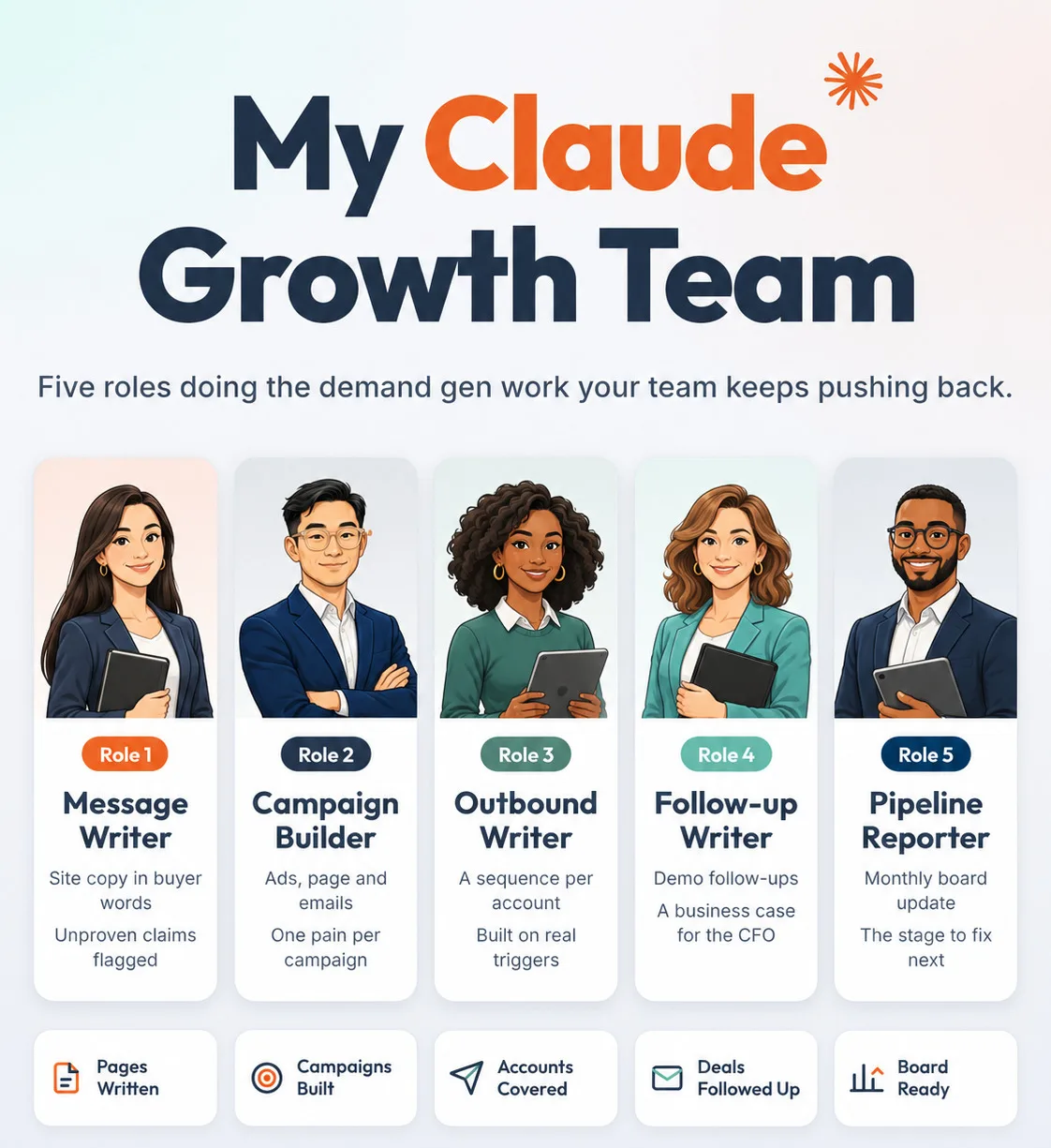

The ClaudeGrowth Team
Five roles in one Claude project, each doing a piece of demand gen work that usually waits for a hire you haven't made yet.
 Brian SheltonFounder, Grow PredictablyFree · 5 Claude roles · 1 Claude project
01 / 10 · Read this first
Who built this, and why
I'm Brian Shelton. I run Grow Predictably, where I help B2B SaaS founders and marketing leaders find the one thing capping their growth and fix that first. I lead AI innovation for a B2B SaaS marketing team, and Grow Predictably runs alongside that.
I set the direction for this one and my team did most of the building. It's five roles in one Claude project, each doing a piece of demand gen work that usually waits for a hire you haven't made yet.
Want to see where your growth is stuck right now? Take the free Growth Gap Scan. It's 16 questions, takes about two minutes, and scores you across the four growth pillars with practical next steps.
02 / 10
What this is
A B2B growth team inside one Claude project. Five roles, each with one job, all reading the same growth brief.
| Role | What you hand it | What you get back |
|---|---|---|
| 1. Message Writer | Sales call notes, your current website | Homepage and product page copy in your buyers' words, with every unproven claim flagged |
| 2. Campaign Builder | One buyer pain from the message file | A full campaign: ad variations, a landing page and three follow-up emails |
| 3. Outbound Writer | Your target account list with a trigger for each | A short sequence for every account, opening on that account's trigger |
| 4. Follow-up Writer | A demo transcript or call notes | The follow-up email, written objection answers and a one-page business case for the CFO |
| 5. Pipeline Reporter | A CRM export | The monthly pipeline update for your CEO or board, ending on the one stage to fix next |
Every draft comes back with a status note at the top:
- Ready to ship. Every claim traces to your brief or your notes. A person still reads it before it goes out.
- Needs your call. A positioning choice, a price mention or a competitor claim that someone with authority has to approve.
- Needs proof first. A claim the role couldn't back up. It stays in the draft, marked, until someone finds the proof or cuts it.
Hand it to whoever runs demand gen on your team. They run the roles. You approve the message, anything that names a competitor, and the pipeline update before it reaches the board.
03 / 10
Before you start
- A Claude account. Projects are available on every plan, including free.
- Five to ten recent sales call notes or transcripts, a mix of won and lost deals. This is the most valuable input in the whole team.
- Your homepage and main product page, pasted as text.
- Your target account list, even a rough one, with one known trigger per account if you have it.
- A CRM export of open and closed deals from the last 90 days: stage, amount, source, created date, close date, owner.
- Two or three things you've written that sound like you. A post, an email, a page you're proud of.
- One owner. Usually whoever runs demand gen.
- Time. About 20 minutes of setup, about an hour for Role 1, then 20 to 40 minutes per role after that, review included.
04 / 10
Setup (about 20 minutes)
- In Claude, go to Projects and click New Project. Name it "Growth Team".
- Click Set project instructions and paste the project instructions below.
- Fill in the growth brief below and add it to project knowledge with the + button on the project page.
- Add your call notes, your two page texts and your writing samples to project knowledge too.
- For each role, open a new chat inside the project and paste that role's instruction.
- When a role finishes, save its output back into project knowledge with the file name it gives you. Other roles read those files.
Project instructions
You are a B2B growth team working for [COMPANY]. Five roles share this project: Message Writer, Campaign Builder, Outbound Writer, Follow-up Writer and Pipeline Reporter. Each chat runs one role.

Rules every role follows:

1. The growth brief in project knowledge is the source of truth. If something you want to write is not in the brief, the call notes or a file in this project, mark it NEEDS PROOF instead of inventing it.
2. Use the buyer's words. When a call note shows how a buyer described a problem, use their phrasing over ours.
3. Never invent a customer, a quote, a number, a result or a logo. Never imply a customer said something they didn't.
4. Write to the person who signs the contract, in plain language. No hype words: revolutionary, game changing, seamless, cutting edge, unlock, supercharge.
5. Start every output with a status line: READY TO SHIP, NEEDS YOUR CALL or NEEDS PROOF FIRST, followed by one sentence saying why.
6. End every output with a file name for saving it back to the project, in the format role_topic_date.
7. If an input is missing, say exactly what you need and stop. Do not fill the gap with guesses.
The growth brief
Fill this in once. Every role reads it. Fifteen honest minutes here saves hours of editing later.
GROWTH BRIEF

Company:
What we sell, in one sentence a buyer would say:
Who signs the contract (title):
Who uses it day to day (title):
Company size and industries we sell to:

The problem we solve, in the buyer's words (paste real phrases from calls):
What buyers use instead of us today (including spreadsheets or doing nothing):
Top three competitors:

What we can prove (each with its source):
-
-
-

What we must never claim:
Pricing we're allowed to mention publicly (or "none"):

Our voice in three words:
Words we never use:

This quarter's growth goal:
The stage we think is capping growth right now (traffic, conversion, sales cycle, expansion):
05 / 10
Run order
- Role 1, Message Writer. Always first. It writes
message_buyer-languageand every other role reads it. - Roles 2, 3 and 4, in whatever order matches your bottleneck. If deals stall after demos, start with Role 4. If the pipeline is thin, start with Role 2 or 3.
- Role 5, Pipeline Reporter, once a month, ideally before your leadership meeting.
06 / 10
The five roles
Each role runs on a ready-made instruction. Open one to see what it does, what to hand it, the instruction to paste and the check before anything ships.
1Message WriterTurns your sales calls into homepage and product page copy in your buyers' own words, and flags every claim it couldn't back up.
What it does. Reads your sales calls, pulls out how buyers describe the problem, and rewrites your homepage and main product page in that language. Anything it can't back up from your notes or brief gets flagged.
What to hand it. The growth brief, five to ten call notes, and your homepage and product page text.
Role: Message Writer.

Read the growth brief, every call note and both page texts in this project.

Step 1. Buyer language file.
Pull every phrase a buyer used to describe:
a) the problem, before they found us
b) what they tried before
c) what made them start looking now
d) what they needed to see before they could buy
Quote them exactly. Group them under those four headings. Mark how many calls each phrase or close variant appeared in. Save this as message_buyer-language.

Step 2. Message.
Write:
- one positioning line a buyer could repeat to their boss
- three core messages, each tied to a buyer phrase from Step 1 and to a proof point from the brief
- for each message, the objection it answers

Step 3. Homepage rewrite.
Rewrite the homepage, top to bottom: headline, subheadline, three benefit sections, a proof section, a "who it's for" section and the call to action. Use buyer phrases from Step 1 wherever they fit. Keep anything from the current page that already works and say why you kept it.

Step 4. Product page rewrite.
Same approach. Lead with the problem in the buyer's words, then what the product does about it, then proof, then how it works, then the call to action.

Step 5. Claim check.
List every claim in both pages. For each one, give its source from the brief or a call note, or mark it NEEDS PROOF.

Format: status line, buyer language file, message, homepage, product page, claim check, file names.
What you get back. A buyer language file, a positioning line with three messages, two rewritten pages and a claim check.
The check before it ships
- Every quote in the buyer language file is word for word from a call note.
- Every NEEDS PROOF item is either sourced or cut.
- The founder or head of marketing has signed off the positioning line. Everything else builds on it.
2Campaign BuilderTakes one buyer pain and builds the whole campaign: ad variations, a landing page and three follow-up emails.
What it does. Takes one buyer pain and builds a whole campaign around it: ads, the landing page they click to, and the emails that follow. One pain per campaign, so the message stays sharp.
What to hand it. The buyer pain you want to run (pick it from message_buyer-language), the channel (LinkedIn, Google or both) and the offer (demo, assessment, guide, webinar).
Role: Campaign Builder.

Read the growth brief and message_buyer-language.

Campaign pain: [PASTE THE PAIN, IN THE BUYER'S WORDS]
Channel: [LINKEDIN / GOOGLE / BOTH]
Offer: [WHAT THE AD ASKS THEM TO DO]

Build:

1. Campaign summary. Who it's for, the one pain it speaks to, the one action it asks for, and how we'll know if it worked (the one number to watch).

2. Ads.
LinkedIn: six single image ads. Intro text under 150 characters, a headline under 70 characters, and an image idea for each. Two ads lead with the pain, two with the outcome, two with a proof point from the brief.
Google: three responsive search ads, each with 15 headlines under 30 characters and four descriptions under 90 characters, written for someone already searching for a solution.

3. Landing page. Headline, subheadline, the pain in the buyer's words, what changes after, three proof points, a short FAQ answering the three most likely objections, and one call to action repeated twice. No navigation menu.

4. Follow-up emails. Three emails for people who took the offer:
Email 1, same day: deliver what they asked for and one useful next step.
Email 2, day three: one insight related to the pain, no pitch.
Email 3, day 7: a direct, low-pressure ask for a conversation.
Each under 120 words, with a plain subject line.

5. Claim check. Every claim in the campaign with its source, or NEEDS PROOF.

Format: status line, then sections 1 to 5, then file names.
What you get back. A ready-to-load campaign: ad copy for both platforms, a landing page and three emails, all built on one pain.
The check before it ships
- The landing page promises exactly what the ad promised.
- Ad character counts fit the platform (Claude can miscount, so check in the ad manager).
- Someone has decided the one number you'll judge the campaign on, before it goes live.
3Outbound WriterWrites a short sequence for each account on your target list, opening on that account's trigger.
What it does. Writes a short sequence for each account on your list, built around something that just happened at that account. Every first line is about them.
What to hand it. Your target list with one trigger per account (new VP, funding round, hiring for a role, a tool change, an expansion) and the person you're writing to at each one.
Role: Outbound Writer.

Read the growth brief and message_buyer-language.

Here is my target list. One row per account: company, contact name, title, trigger, source of the trigger.
[PASTE LIST]

For each account, write:

1. Why now. One sentence connecting their trigger to a pain from message_buyer-language. If the connection is weak, say so and suggest a better angle or skip the account.

2. A three email sequence:
Email 1: open on the trigger, connect it to one pain, ask one easy question. Under 90 words.
Email 2, day four: one useful idea or example they can use even if they never reply. Under 80 words.
Email 3, day nine: a short, polite close. Under 50 words.

3. One LinkedIn connection note under 200 characters.

Rules:
- The first line is about them, never about us.
- No fake familiarity ("hope you're well", "quick question"), no false urgency.
- Never claim we work with a company unless the brief says we can name them.
- Only use the trigger as given. Do not guess anything else about the person or company.

Finish with a table: company, trigger, angle used, and any account you recommend skipping, with the reason.

Format: status line, sequences, table, file name.
What you get back. A sequence per account, a LinkedIn note per contact, and a table showing which angle each account got.
The check before it ships
- Every trigger is real, recent and sourced. A wrong trigger in line one costs you the account.
- Someone who knows the market has read the accounts the role suggested skipping.
- The sequences go out from a real person's inbox, at a volume your domain can handle.
4Follow-up WriterTurns each demo transcript into the follow-up email and a one-page business case your champion can forward to their CFO.
What it does. Turns each demo into the follow-up your buyer actually needs: the recap email, written answers to the objections from the call, and a one-page business case the champion can forward to whoever signs.
What to hand it. The demo transcript or detailed notes, the deal stage and who else is involved in the decision.
Role: Follow-up Writer.

Read the growth brief and message_buyer-language.

Demo transcript or notes: [PASTE]
Who was on the call (name, title): [LIST]
Who else decides or signs: [LIST, IF KNOWN]
Agreed next step, if any: [PASTE]

Write:

1. The follow-up email to the champion. Recap their problem in their own words from the call, the two or three things they reacted to most, the agreed next step with a date, and nothing else. Under 180 words.

2. Objection answers. List every concern, question or hesitation raised on the call, quoted. For each, write a short, honest answer using only what the brief supports. If the honest answer is "we don't do that", say so and suggest how to handle it.

3. One-page business case, written for the person who signs (usually the CFO or CEO):
- The problem, in the champion's words
- What it costs them today (use only numbers they gave on the call; if none, list the questions to ask so we can fill it in)
- What changes with us
- What it costs and what's needed from their team (only if pricing is allowed in the brief)
- The risks, honestly, and how we reduce them
- The next step
Plain language, no jargon, fits on one page.

4. Gaps. Anything we promised on the call that needs a follow-up from someone on our side.

Format: status line, sections 1 to 4, file name.
What you get back. A follow-up email, an objection sheet and a business case your champion can forward without rewriting.
The check before it ships
- Every number in the business case came from the buyer, not from Claude.
- The sales owner has checked the objection answers against what the product actually does.
- Anything listed under Gaps has an owner and a date.
5Pipeline ReporterTurns your CRM export into the monthly pipeline update for your CEO or board, ending on the one stage to fix next.
What it does. Turns your CRM export into the monthly pipeline update for your CEO or board: what moved, what's stuck, and the one stage to work on next. It writes the update. You decide what's true.
What to hand it. A CRM export from the last 90 days (stage, amount, source, created date, close date, owner, lost reason) and last month's update if you have one.
Role: Pipeline Reporter.

Read the growth brief. Here is our CRM export: [ATTACH OR PASTE]
Last month's update, if any: [PASTE]

Step 1. Data check. Before any analysis, list problems in the data: missing stages, missing amounts, deals with no source, close dates in the past on open deals, duplicates. Say how each one could distort the numbers. Do not fix the data silently.

Step 2. The numbers. Calculate, for this month and last:
- new pipeline created (count and value), by source
- conversion between each stage
- average days in each stage
- deals won and lost, with lost reasons grouped
- deals open more than twice the average cycle
Show your working in a table so a person can check it.

Step 3. The constraint. Name the one stage where the most deals or value is getting stuck or lost. Explain it using only the numbers above. Name the second candidate too, and what would have to be true for it to be the real one.

Step 4. The update. Write a one-page update for the CEO or board:
- the headline in one sentence
- three numbers that matter, each with last month for comparison
- what moved and why we think so (mark anything that's a guess as a guess)
- the stage to fix next and the one thing we'll do about it this month
- what we need from leadership, if anything
No vanity metrics. If a number doesn't change a decision, leave it out.

Format: status line, data check, numbers table, constraint, update, file name.
What you get back. A data check, a numbers table you can verify, the stage to work on next and a one-page update ready for your leadership meeting.
The check before it ships
- Someone has recalculated two or three of the numbers from the raw export. If they don't match, nothing goes up.
- Every "why we think so" line is labeled as a judgment, not a fact.
- The update ends on one stage and one action, not a list of ten.
07 / 10
A month with it
Week one. Fill in the brief. Run Role 1. Get the positioning line signed off.
Week two. Run the role that matches your bottleneck: Role 2 or 3 if the pipeline is thin, Role 4 if deals stall after demos.
Week three. Ship what's approved. Run Role 4 after every demo from here on.
Week four. Run Role 5 before your leadership meeting. Let its "stage to fix next" decide which role you lean on next month.
08 / 10
What this won't do
It won't ship anything. Every output is a draft. Your team edits, approves and sends.
It can't make up for thin inputs. Generic call notes and an empty brief give you generic copy. The better the inputs, the less you edit.
It doesn't know your market better than your sales team. Claude reads the call notes. It didn't sit in the calls.
It can't fix bad data. The Pipeline Reporter flags problems in your CRM export, but if stages and sources aren't tracked, no report can tell you where deals stall.
It won't guarantee results. It gets the work written. Whether it works is something you measure after it's live.
Claude can be wrong in a convincing way. Check every fact, number and quote before anything goes out under your name.
09 / 10
Sources
- Claude Help Center, How can I create and manage projects? (creating projects, project knowledge, project instructions, availability on free plans). https://support.claude.com/en/articles/9519177 (checked October 25, 2026)
10 / 10 · Not sure where to start?
Not sure which role to start with?
Every role is here, and nothing is held back. The hard part is knowing where to point it, because that depends on where your growth is actually stuck.
That's what the Growth Gap Scan is for. It's free.
- 16 questions, about two minutes
- A score across the four growth pillars: attract, convert, ascend and accelerate
- Which of the twelve growth accelerators you already have, and which are missing
- A report with practical steps you can take right away
- Results on screen as soon as you finish
If the scan points to a gap worth talking through, there's a strategy call behind it.
The score is a starting point, not a promise about results.