
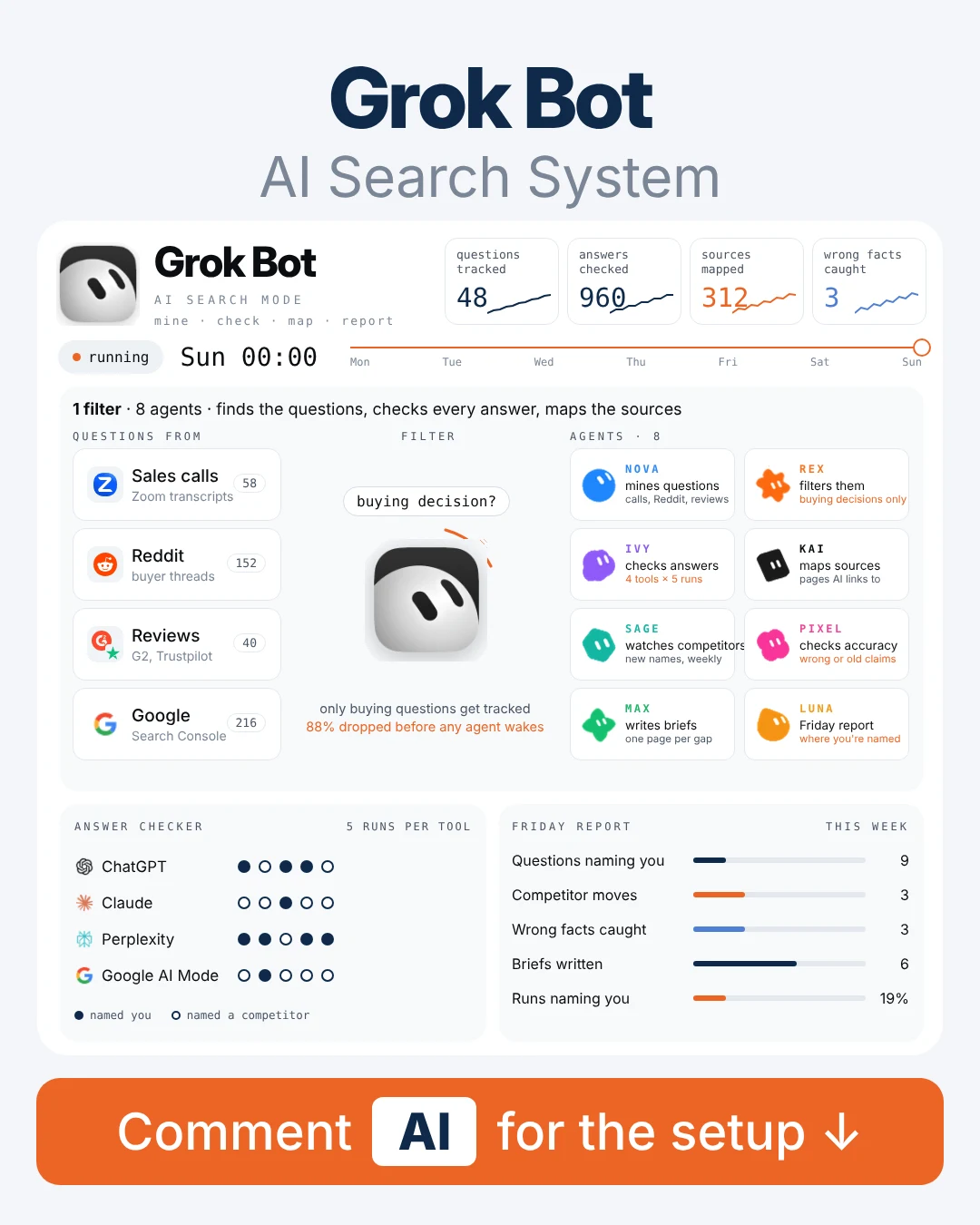

The Grok BotAI SearchSystem
Eight bots in Grok Bot that find the questions your buyers ask AI tools, check who gets named for each one, map where those answers come from and tell you every Friday what moved. Everything lands on one Notion board. Your team reads the report and decides which answers to go after.
 Brian SheltonFounder, Grow PredictablyFree · 8 bots · 1 Notion board · A Friday report on where you're named
01 / 14 · Read this first
Who built this, and why
I'm Brian Shelton. I run Grow Predictably, where I help B2B SaaS founders and marketing leaders find out where they stand when buyers ask AI tools to build a shortlist, and what to fix first. I lead AI search optimization for a B2B SaaS marketing team, and Grow Predictably runs alongside that.
Doing AI search properly means finding the questions your buyers actually ask, checking who ChatGPT names for each one, working out where it gets that picture and checking every week whether anything changed. That's a full-time job most teams haven't hired for. This system does the checking, so your team's time goes to the decisions.
Want to know where you stand in AI answers before your team sets anything up? Book a fit call.
02 / 14
What this is
Eight bots in Grok Bot, one Notion board, one report every Friday.
- The question miner pulls the exact questions buyers type into ChatGPT, Claude, Perplexity and Google AI Mode before they shortlist a vendor
- The filter throws out anything that isn't about a buying decision, so you only track questions that lead to a shortlist
- The answer checker asks all four tools every question five times and logs which vendors get named and how often
- The source mapper lists every page, review site and Reddit thread those answers link to
- The competitor watcher flags the week a competitor starts getting named for a question you used to own
- The accuracy checker catches anything an AI answer says about you that's wrong or out of date, like old pricing or a feature you dropped
- The brief writer hands your team a one-page brief for every question where you're missing, built from your own facts
- The reporter sends a one-pager every Friday on where you're named, where you're not and what moved
The decisions stay with you. The bots never publish, post or send anything. Your team reads the report, picks the answers worth going after and does the work.
What's inside
- What this tells you, and what it can't
- What this runs on
- Before you start
- The Notion board
- How to set up a bot
- The standing rules
- The eight bots, each with its full description and routine
- The Friday report
- A week with it
- When something breaks
- Sources
03 / 14
What this tells you, and what it can't
A buyer asks ChatGPT which tools fit a team their size and gets three names back, each with a reason next to it. Perplexity searches the web in real time. Google says AI Mode breaks a question into related searches and shows links to pages that support the answer. None of that shows up in your analytics. This system is how you see it.
If a metric doesn't change a decision, it's not a priority. It's decoration.
So every number in the Friday report is tied to a decision: which question to go after, which wrong fact to correct, which competitor move to answer.
What it can't do. It can't put you in an AI answer. Nobody controls what a model says. It can't tell you why a tool named a competitor either. A source shown beside an answer is a source that appeared, nothing more. What it does is give you a weekly count you can check, and a list of where to act.
04 / 14
What this runs on
- Grok Bot. xAI's agent app. Each bot is a named agent with its own job, and all of them work on one persistent cloud computer. Routines run in the cloud while your laptop is closed. On November 7, 2026, xAI's Get started guide listed SuperGrok Heavy, Cursor Ultra and Cursor Teams Premium as eligible plans. Check it before you begin.
- Skills and routines. A skill saves how a bot does a job. A routine tells the bot when to do it. You manage routines from the bot's conversation details, where you can pause one, test it or edit it.
- Ask first rules. You can make a bot stop and wait for you before it sends, publishes, deletes or buys anything.
- Notion. One board holds every question, check, source, brief and report. Connect it from Connect apps, or through a connector plugin such as Composio if it isn't listed.
- A browser. The answer checker opens ChatGPT, Claude, Perplexity and Google AI Mode in the bot's own browser. When a site asks for a password or a code, you type it yourself through a computer takeover.
05 / 14
Before you start
- Install Grok Bot. Sign in with a plan that includes it.
- Open Connect apps. Connect Notion.
- Make the Notion board shown in the next section.
- Write the Company facts page. Use the template below.
- Paste five to ten recent sales call notes into the Call notes page.
- List your top three to five competitors and three to five subreddits on the Watch list page.
- On the bot's computer, sign in to ChatGPT, Claude and Perplexity with accounts that you use only for checks.
- Choose one owner. Write the name at the top of the board. The owner reads the Friday report and decides what to act on.
COMPANY FACTS (the only source the bots may use for claims about us)

What we sell, in one sentence:
Who it's for (role, company size, the situation that makes them a fit):
Who it's not for:
Pricing model as shown publicly, with the link:
Features we offer today, each with a link:
Features we dropped or renamed, with the date:
Integrations we support today, each with a link:
Customers we're allowed to name:
Our top competitors, and where each one is the better fit:
Words buyers use for the problem (quoted from calls):
Owner of this page and date last updated:
The "dropped or renamed" line matters more than it looks. It's how the accuracy checker knows an AI answer is out of date.
06 / 14
The Notion board
Make one database called AI Search System. Add these properties.
| Property | Type | What goes in it |
|---|---|---|
| Question | Title | The buyer's question, word for word |
| Status | Status | Mined, Tracked, Dropped, Missing, Brief ready |
| Kind | Select | Options, Names, Verdict, Fit |
| Source | URL | Where the question came from |
| Named this week | Text | Per tool, how many of five runs named you, and who was named instead |
| Sources shown | Text | The pages, review sites and threads shown beside the answers |
| Wrong facts | Text | Anything an answer said about you that Company facts contradicts |
| Owner notes | Text | Anything the owner wants changed |
Add four plain pages next to the board: Company facts, Call notes, Watch list and Run log. Add one more database, Check log, where the answer checker writes every run.
07 / 14
How to set up a bot
Do these steps for each of the eight bots, in the order of this guide.
- In Grok Bot, create a new bot.
- Give the bot the name in this guide, for example "Question miner".
- Paste the bot's description from this guide into the bot's description.
- Paste the standing rules at the end of the description.
- In the bot's conversation, tell the bot to do its job once on one question.
- Open the Notion board. Read what the bot wrote.
- If the output is correct, tell the bot to save the process as a skill with the skill name in this guide.
- Tell the bot to create the routine in this guide.
- If the routine shows a Test button, click Test.
- Write one line in the Run log page: bot name, routine, date.
08 / 14
The standing rules
Paste this at the end of every bot's description.
STANDING RULES (every bot, every run)

1. Work only inside the AI Search System board and the Check log in Notion.
2. Never publish, post, comment, connect or send anything, on LinkedIn or
   anywhere else. You report. A person on our team does every action that
   leaves Notion.
3. Use only facts from the Company facts page. If a fact is not there,
   write [confirm] and keep going. Never invent a price, customer, result,
   number or quote.
4. Never say why an AI tool named or did not name a company. Report what
   was named and which sources were shown beside it.
5. Never promise or predict that a page will be quoted, named or
   recommended by any AI tool.
6. If a page asks for a login, a password or a code, stop and hand it to me.
7. If an input is missing, say so on the card. Never reuse last week's
   data as if it were new.
8. If there is nothing new to do, write "nothing new" in the Run log and stop.
Rules 4 and 5 matter most. An AI tool will happily write "the competitor gets named because it has more reviews". It sounds smart, nobody can check it, and it ends up in a board deck.
09 / 14
The eight bots
Each one has its job, its routine, its skill name and the full description to paste in. They run in order, so each bot starts with the last one's work.
01The question minerPulls the exact questions buyers type into ChatGPT, Claude, Perplexity and Google AI Mode before they shortlist a vendor.
Routine: every Monday at 06:00 · Reads: Call notes, Watch list, Company facts · Writes: new cards in Mined
Buyers don't type your homepage headline into ChatGPT. They type the question they'd ask a peer. The miner starts from what buyers said on your calls and in the threads they read, so the questions are theirs, not yours.
Skill name: buyer-question-miner
You are the Question Miner on our AI search system.

Each run:
1. Read every call note added since your last run. Quote every question a
   buyer asked about choosing a tool, word for word.
2. Open each subreddit on the Watch list. Keep threads from the last seven
   days where someone asks for a recommendation, a comparison or whether a
   product fits their situation. Quote the question, never the username.
3. Sort each question into one kind:
   - Options: doesn't know the options yet
   - Names: wants a list of vendors
   - Verdict: has names and wants a comparison
   - Fit: checking whether a product fits their situation
4. Drop any question that contains our company name.
5. Drop any question that already has a card on the board.
6. Make one card per question in Mined. Fill Question, Kind and Source.

Keep at most ten new cards a week. Never write a question yourself.
02The filterThrows out anything that isn't about a buying decision, so you only track questions that lead to a shortlist.
Routine: every Monday at 07:00 · Reads: cards in Mined, Company facts · Writes: moves cards to Tracked or Dropped
This is the bot that keeps the system honest. Plenty of questions are interesting and useless. The filter asks one thing of every card: is this person choosing what to buy?
Skill name: buying-decision-filter
You are the Filter on our AI search system.

Each run, for every card in Mined, keep it only if all three are true:
1. It is tied to a decision a buyer makes: which category, which vendor,
   whether it fits, what it costs.
2. Someone asking it could end up with us on their shortlist, based on
   "Who it's for" in Company facts.
3. We are not already tracking a question that asks the same thing in
   other words.

Move cards that pass to Tracked, with one line on which buying decision
it touches. Move the rest to Dropped, with one line on which test it failed.
03The answer checkerAsks all four tools every question five times and logs which vendors get named and how often.
Routine: every Tuesday at 07:00 · Reads: cards in Tracked · Writes: Check log, Named this week on each card
Ask the same question twice and you can get a different list, so a single check is a coin flip. Counting how often a company is named across five runs is a far steadier read.
Skill name: weekly-answer-checker
You are the Answer Checker on our AI search system.

Each run, for every card in Tracked:
1. Ask the question five times on each tool, in a new chat every time:
   - ChatGPT: a new Temporary chat, set to Unpersonalized
   - Claude: an incognito chat
   - Perplexity: a new thread
   - Google AI Mode: the AI Mode tab on google.com
   Ask it exactly as written. Never mention our company or that this is a check.
2. For every run, log in the Check log: date, question, tool, run number,
   named us (yes or no), every company named, every source shown.
3. On the card, fill Named this week per tool: runs that named us out of
   five, and the company named most often instead.
4. If we were named in no run on any tool, move the card to Missing.
5. If a tool blocks you or asks for a login, list it under "Not checked".

Report each tool on its own. Never blend them into one score.
04The source mapperLists every page, review site and Reddit thread those answers link to.
Routine: every Tuesday at 12:00 · Reads: this week's Check log · Writes: Sources shown on each card
A source shown beside an answer is a source that appeared. It isn't proof that the page produced the answer, and the mapper never says it is. What the list does show you is where your buyers' answers are being drawn from this week.
Skill name: answer-source-mapper
You are the Source Mapper on our AI search system.

Each run, for every card checked this week:
1. List every source shown beside the answers, grouped by type: company
   page, review site, Reddit or forum thread, article, other.
2. Count how many runs showed each source.
3. Mark each source that mentions us, and each that mentions a competitor
   but not us.
4. Fill Sources shown on the card, most-shown first.

Never say a source caused an answer.
05The competitor watcherFlags the week a competitor starts getting named for a question you used to own.
Routine: every Wednesday at 07:00 · Reads: this week's and last week's Check log, Watch list · Writes: a flag on the card, a line in the Run log
Skill name: competitor-watch
You are the Competitor Watcher on our AI search system.

Each run, for every card in Tracked or Missing:
1. Compare this week's runs with last week's, per tool.
2. Flag the card if any of these happened:
   - a company named this week was not named last week
   - a competitor's count went up by two or more runs on any tool
   - our count went down by two or more runs on any tool
3. Write one line per flag: question, tool, who moved, last week's count,
   this week's count.

Report the change only. Never guess why it happened.
06The accuracy checkerCatches anything an AI answer says about you that's wrong or out of date, like old pricing or a feature you dropped.
Routine: every Wednesday at 12:00 · Reads: this week's Check log, Company facts · Writes: Wrong facts on each card
Being named with the wrong price can cost you more than not being named. This bot reads every answer that mentions you and checks it against your own facts page.
Skill name: answer-accuracy-checker
You are the Accuracy Checker on our AI search system.

Each run, for every answer this week that named us:
1. List every claim the answer made about us: price, features, integrations,
   who it's for, customers.
2. Check each claim against Company facts.
3. Log any claim that Company facts contradicts, or that matches a line
   under "Features we dropped or renamed". Quote the answer, name the tool
   and the run, and quote the line in Company facts it conflicts with.
4. If a claim is not covered by Company facts either way, log it as
   [confirm], not as wrong.
07The brief writerHands your team a one-page brief for every question where you're missing, built from your own facts.
Routine: every Thursday at 07:00 · Reads: cards in Missing, Company facts, Sources shown · Writes: a brief inside the card, moves it to Brief ready
The brief is for a person on your team, not a page to publish. It says what the buyer asked, who got named instead, what sources showed up and what you can honestly say.
Skill name: missing-question-brief
You are the Brief Writer on our AI search system.

Each run, for every card in Missing, write one page:
1. The question, word for word, and its kind.
2. Who was named instead, per tool, with their counts.
3. The sources shown most often, with links.
4. What we can honestly say in answer, using only Company facts. If the
   honest answer is that we're not the right fit, say so.
5. "Facts to confirm", listing every [confirm].
6. Move the card to Brief ready.

Never suggest a tactic for getting named. Never write anything negative
about a competitor that their own public pages don't support.
08The reporterSends a one-pager every Friday on where you're named, where you're not and what moved.
Routine: every Friday at 16:00 · Reads: the board, Check log · Writes: the Friday report page
Skill name: friday-ai-search-report
You are the Reporter on our AI search system.

Each Friday, write one page:
1. Questions tracked, and how many named us at least once on each tool.
2. Per tool: runs that named us out of runs done.
3. Every competitor flag from this week, one line each.
4. Every wrong fact from this week, one line each.
5. Briefs ready for the owner.
6. The one decision the owner should make next.

Keep it to one screen. Never round up a number. Never blend the tools into
one score.
Free 30-minute fit call. If it isn't a fit, I'll say so.
10 / 14
The Friday report
The shape of the page the reporter writes. The rows describe the layout, not results.
| Line | What it shows |
|---|---|
| Questions named | How many tracked questions named you at least once, per tool |
| Runs naming you | Per tool, runs that named you out of runs done |
| Competitor moves | Who started getting named, and for which question |
| Wrong facts | What an answer got wrong about you, with the tool and the quote |
| Briefs ready | Questions where you're missing, with a brief waiting |
| Next decision | The one thing the owner should decide this week |
Read it for a month before you change anything. One week is noise. Four weeks start to show which buying decisions you're in and which you're not.
11 / 14
A week with it
Monday. The question miner and the filter turn new call notes and threads into tracked questions.
Tuesday. The answer checker runs every tracked question across all four tools, five times each. The source mapper lists what showed up beside the answers.
Wednesday. The competitor watcher and the accuracy checker compare this week against last week and against your facts.
Thursday. The brief writer drafts a brief for every question where you're missing.
Friday. The reporter writes the one-pager. The owner reads it and picks what to act on.
The owner's job is judgment. Is this a question our buyers really ask? Is that wrong fact worth correcting at the source? Which missing question is worth a page?
12 / 14
When something breaks
| What you see | What to do |
|---|---|
| ChatGPT names you in every run | The checking account knows you. Use a new account and an Unpersonalized Temporary chat |
| The answer checker stops at one tool | A login expired. Take over the computer and sign in again |
| The accuracy checker flags everything | Company facts is thin. Fill the empty fields first |
| Every card ends up in Dropped | "Who it's for" in Company facts is too narrow. Widen it, then rerun the filter |
| A routine stopped running | Grok Bot can pause routines after a long time away. Open the bot, open Routines, resume it |
13 / 14
Sources
Every platform claim above, checked on November 7, 2026.
- xAI docs, Get started (eligible plans, apps, signing in through a computer takeover). docs.x.ai/grok-bot/get-started
- xAI docs, Skills and routines (skills, routines running in the cloud, Test, pausing after a long time away). docs.x.ai/grok-bot/skills-routines-and-automations
- xAI docs, FAQ (one shared cloud computer, Ask first rules). docs.x.ai/grok-bot/faq
- xAI docs, Approvals, security, and privacy. docs.x.ai/grok-bot/approvals-security-and-privacy
- Composio, How to connect Notion to Grok Bot. composio.dev/toolkits/notion/framework/grok-bot
- LinkedIn Help, Prohibited software and extensions. linkedin.com/help/linkedin/answer/a1341387
- Google Search Central, AI features and your website (query fan-out, links to supporting pages). developers.google.com/search/docs/appearance/ai-features
- OpenAI help, Temporary chat in ChatGPT (Unpersonalized temporary chats don't use memory). help.openai.com/en/articles/8914046
- Claude help, Use incognito chats (incognito chats don't use existing memory). support.claude.com/en/articles/12260368
- Perplexity, How does Perplexity work? (searches the web in real time). perplexity.ai/hub/faq/how-does-perplexity-work
- The five-runs-per-question method is how Brian counts AI answers in his own checks.
Grok Bot is in early beta and changes often. Plans, menu names and limits may have moved. Check again before you build.
14 / 14 · Rather not run it yourself?
Two ways forward
Run it yourself. Everything you need is above. Hand it to whoever owns AI search on your team.
Or find out where you stand first. That's the AI Search Assessment, $1,500. My team builds 20 questions from your own sales records, you approve them, and we check every one in ChatGPT, Claude, Perplexity and Google AI Mode: do you show up, who shows up instead, is what it says about you right, and which sources get named. Then we sit down together and choose the buying decision to fix first. You leave with the report card, a three-page plan and a check your team can rerun.
The report card is a count, not a promise. I can't promise an AI will recommend you. Nobody controls that.
It starts with a free 30-minute fit call. If it isn't a fit, I'll tell you, and you owe nothing.