

The Buyer QuestionBenchmark
Eleven steps, in order. Start with the questions buyers ask when they are choosing.
 Brian SheltonFounder, Grow PredictablyFree · 11 steps · 1 worked example
01 / 04 · Read this first
How to Find the Buyer Questions Worth Measuring
Grow Predictably · September 2026
02 / 04 · The 11 steps
The Framework
Eleven steps, in order. Start with the questions buyers ask when they are choosing. Then ask those questions in the AI tools they actually use. The examples use fintech because fintech shows the mistakes fastest.
01List what the buyer has to satisfyDo this before you write a single question.
Write down the things that decide deals in this market. For a fintech company selling an AI product, that list usually includes:
- The rules they have to follow. SOC 2, PCI DSS, the Bank Secrecy Act, customer data rules, ACH rules, state licenses where money moves.
- Who audits them, and what that auditor asks about outside software.
- Whether a decision the AI makes has to be explained to somebody who got turned down.
- What it has to connect to. The core banking system, the ledger, the identity checker, the data warehouse.
- Where the data can live, and whether it trains anything.
- How many transactions or applications a month.
- Who signs. A controller signs for software. A risk committee signs for anything that touches lending.
Every question you keep has to carry at least one item off this list.
How to check your work. Read a question out loud. If any company in any industry could have asked it, it isn't specific enough yet.
02Sort into the four kinds of question a buyer asksA buyer asks four different kinds of question on the way to a shortlist.
- They don't know who the players are. "What are credit unions using instead of a credit scorecard?"
- They want names. "Best AI underwriting platform for a community bank."
- They have names and want a verdict. "Alternatives to the underwriting module in our core system."
- They're checking whether it works for them. "Can an AI model satisfy fair lending rules?"
For fintech, out of 20 questions, aim for roughly three of the first kind, 7 of the second, five of the third, and five of the fourth.
Most people write nothing but the second kind. That gives you a set that looks fine and never finds the place you're actually losing the deal. In financial services the deal usually dies on the fourth kind, in the fit conversation, on a compliance objection.
How to check your work. Count them. If one kind is more than half the set, rebalance.
03Take out every question with the company's name in itPeople inside the company will send you questions like "what does ChatGPT say about us." That's a fair thing to want to know. It's a different test.
- Questions with the name go to the brand comprehension test, which grades what AI believes about the company.
- Questions without the name go to the benchmark, which answers one thing: when a stranger is choosing and has never heard of you, do you come up?
Never mix the two.
In our own run, eight of the 17 questions the company started with had the company name in them. None were thrown away. They moved to the other test.
04Take out every question written in the company's own wordsThis is the step most people get wrong. We got it wrong on ourselves first.
When we built the first question set for Grow Predictably, four of six questions used phrases straight off our own website. Nobody outside the company has ever typed them. We had built a test of whether AI could find us using words only we use.
The check. Would somebody who has never seen this company's website type this sentence?
Fintech is full of company words. "Embedded finance." "Orchestration layer." "Intelligent automation." "Unified platform." "AI-powered insights." Buyers don't say any of that. They say their auditor asked how the model decides. They say three people are keying in invoices by hand. They say they can't close the books on time.
Rewrite every question in the buyer's words.
05Cut what's left, using four checksKeep a question only if it passes all four.
- Would the answer name companies? If the honest answer is a definition or a how-to, that's a blog post, not a benchmark question.
- If this company is missing from the answer, does a sale get harder? If nothing changes, cut it.
- Will it still make sense in three months? Anything with a year in it stops being comparable in January.
- Would the answer say something about the company besides its name?
The fourth check is ours, and it's the one that decides whether a question is worth anything.
Compare these two:
"Best AI underwriting platform."
That gets you a ranked list. You learn your position and nothing else.
"Best AI underwriting platform for a community bank that has to give turn-down reasons and pass a model review."
That makes the AI explain itself, and the explanation is where everything useful lives.
We have proof. In one run, the plain question gave us a rank and stopped. The question carrying a real constraint gave us four separate findings, including an AI naming a product the company had retired years earlier.
Rule of thumb. Put in the question about the thing the company is weakest on. A set that steers around it comes back clean and teaches nobody anything.
06Run all 20 questions in all four toolsChatGPT, Claude, Perplexity, Google AI Mode.
- A fresh chat for every question.
- Memory and personalization off wherever the tool has the setting.
- A screenshot of every answer.
- The date on every row.
ChatGPT and Google AI Mode work signed out. Claude and Perplexity need an account, so use a clean one kept only for measuring. Write down which way you ran each tool, because whoever re-runs this next needs to match your conditions.
20 questions across four tools is 80 answers.
07Grade each answer instead of counting itA yes-or-no column can't hold anything worth paying for.
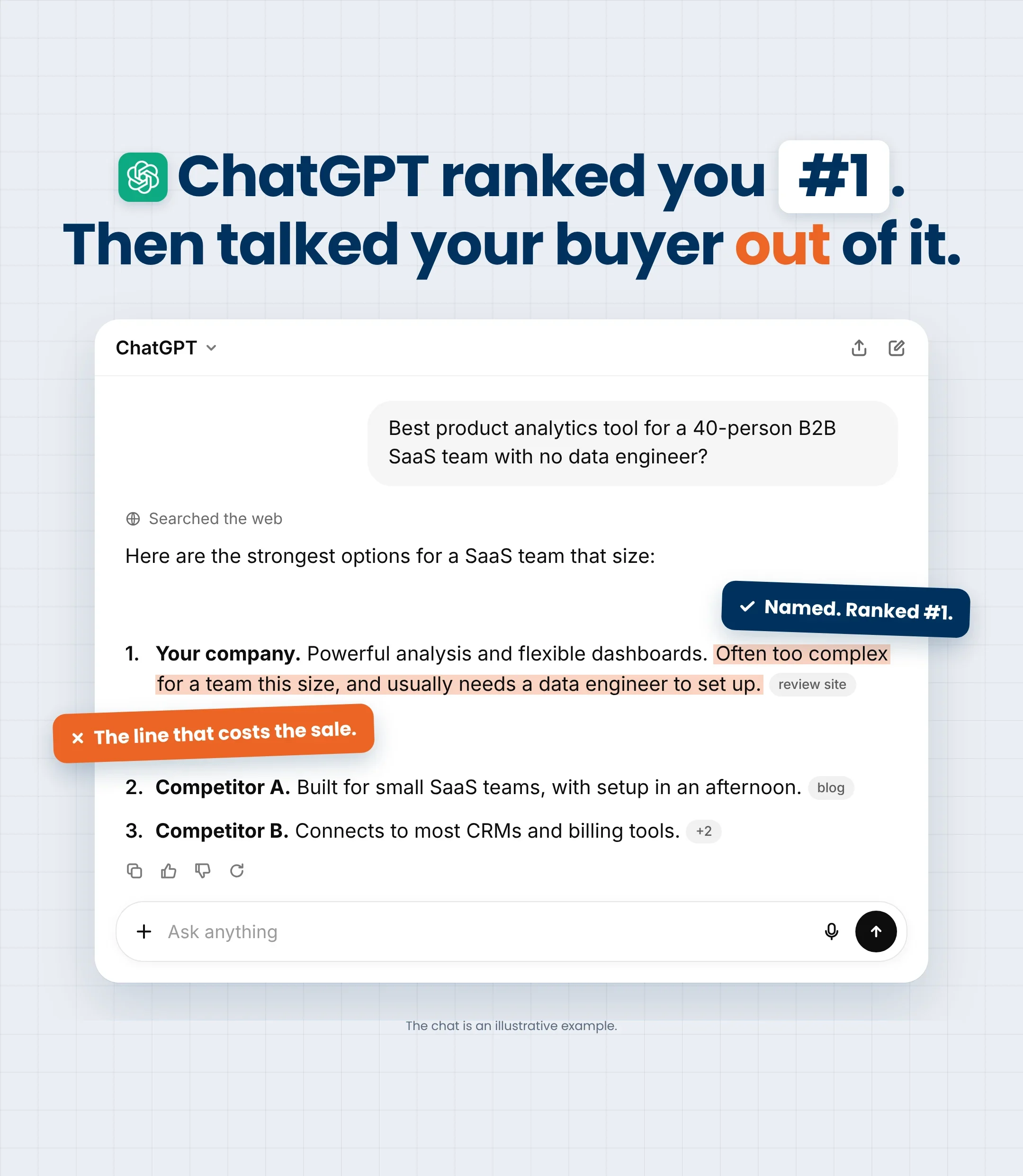
The leader we measured was named in 11 of 12 answers and ranked first in eight. By the count, that's a pass, and we would have sent the company home happy. Every real problem was in the description.
Grade every answer as one of these:
- Not named.
- Named, but ranked under a competitor.
- Named, then described in a way that costs the sale. Too big. Too complex. Needs a specialist on staff to run it.
- Named with something wrong. An old product name. A capability called unproven when it isn't.
- Named, but the credential is missing while a competitor's is sitting right there.
That last one is the fintech one, and it's usually a publishing problem rather than a product problem.
08Report each tool separatelyOn one question in our run, some tools put the company first while another left it off the shortlist. Same question, same day.
A single score may hide that disagreement. The disagreement is worth reporting.
Worth knowing: different tools can use different sources or treat the same source differently. That difference may not have a writing fix. It may simply reflect how the tools work, and whoever reads the report should hear it plainly.
09Read the sources listed under each answerThis is the most useful thing the run produces, and you can't see any of it from a mention count.
In one run, the sources showed a smaller competitor winning on a library of documents written for each individual state. That isn't an insight. That's an instruction. Here is the thing they published and you didn't.
In fintech, look at what the winners are cited for:
- Setup and integration guides for the specific systems the buyer already runs
- Security and compliance documents somebody can actually read, not gated behind a form
- A written explanation of how the model decides, aimed at an auditor
- Named customers on review sites the AI tools pull from
Whatever they're cited for and you aren't is the to-do list.
10Write down what happened to every question you started withKept. Reworded. Merged with another one. Moved to the brand test. Cut. One line each, with the reason.
This is the part people remember. If you cut a question someone cared about, they can see why, and they can overrule you.
11Write down the exact conditionsThe wording of every question. The four tools. A fresh chat each time. Personalization off. Signed in or signed out, per tool. The date.
If anyone changes a question's wording later, that question starts over and can't be compared to the old version. That rule is the only reason the second measurement means anything.
03 / 04
A worked example
The company. An AI credit decisioning platform, 35 people, selling to community banks and credit unions. It underwrites consumer loans with a model instead of a fixed scorecard.
Step 1, what the buyer has to satisfy. They get examined, and the examiner asks about outside software that touches lending decisions. Anyone turned down has to be given specific reasons, so the model's output has to be explainable in writing. It has to connect to the core banking system they already run. Consumer data can't leave the country or train anything shared. A few hundred to a few thousand decisions a month. A risk committee signs, not a CTO.
Who they get compared to. The named AI lending vendors, the analytics modules built into the core banking platforms, and the honest fourth option, which is keeping the scorecard they already have.
One question of each kind.
They don't know the players. "What are credit unions using instead of a traditional credit scorecard to underwrite consumer loans?" Carries: their own institution type. If this company is missing, the buyer starts from a list that doesn't include it.
They want names. "Best AI underwriting platform for a community bank that has to give turn-down reasons and pass a model review." Carries: the examiner and the turn-down requirement. This is the main one, and it's in the buyer's words.
They want a verdict. "Alternatives to the underwriting module in our core banking platform, for a credit union that wants better approval rates without replacing the core." Carries: what it has to connect to. Goes after the incumbent without asking the buyer to imagine a migration they'll never approve.
They're checking fit. "Can an AI underwriting model satisfy fair lending requirements, and which vendors will produce the documentation an examiner asks for?" Carries: who signs. This is the question most likely to come back with something damaging, which is exactly why it stays in.
What to tell the company to expect. We don't promise what any tool will say. What they get is a graded record, tool by tool, of how they're described when AI is choosing under each of those conditions, plus the list of sources showing what their competitors published. Whether the news is good isn't ours to decide in advance, and a set built to come back clean wouldn't be worth running.
04 / 04
What a person still has to decide
The framework gets you to the decisions. It doesn't make them.
A model can draft questions. It can't tell you whether buyers in this market actually name that competitor, whether a criticism an AI tool raised is unfair or just true, whether an old product name showing up is urgent or a curiosity, or whether the thing the founder is most defensive about is the thing costing them deals.
Those calls are the assessment. The question set is how you get to them.